Tangled Marine Industries: Part 1
This month’s blog follows my own pre-Phippsburg meandering, exploring the various experiences that have shaped why I care about fisheries so much. I’ve chopped it into three parts. Here’s the first and I’ll send the next two out over the coming, snowy week. Stay warm, all!
Part 1
RECENTLY, RICHARD LEE of Small Point and Warren told me a story from his tuna fishing days, back in the seventies, when he was a fisherman on the Hazel A.
One day, Richard was at the wheel while his captain got some sleep below. They were just entering the New Meadows River, steaming to shore after a long trip, when Richard spotted something strange: A large, metal sphere was knocking against the shoreline rocks. He turned the boat hard, maneuvering closer to get a better look.
Woken from sleep by the sudden shift and assuming Richard had spotted a fish, his captain raced up to the deck. As the Hazel A drifted closer, Richard and his captain saw several spikes protruding from the top of the sphere.
“Pull off, boy! Pull off!” Richard’s captain cried.
This was no fish, but a massive, unexploded ordnance, a World War II naval mine, submerged three decades earlier and now, washed up by time and tides, knocking idly around the quiet banks of the New Meadows. Those spikes they saw were trigger points, designed to trip should a submarine ever scrape too close on its way through that Midcoast channel.
Nobody on shore believed Richard–not until they read the story in the Times Record the next day. The Coast Guard arrived, “with a big old hauser on the mine,” Richard said. He wanted to follow the cutter out to watch, but his captain told him to leave it be.
The Guard dragged the mine far offshore and fired on it. Even out of sight, Richard said the resulting detonation was immense.
Richard isn’t the only fisherman around here to tell me about discovering leftover, sometimes potentially catastrophic scraps of wars gone by.
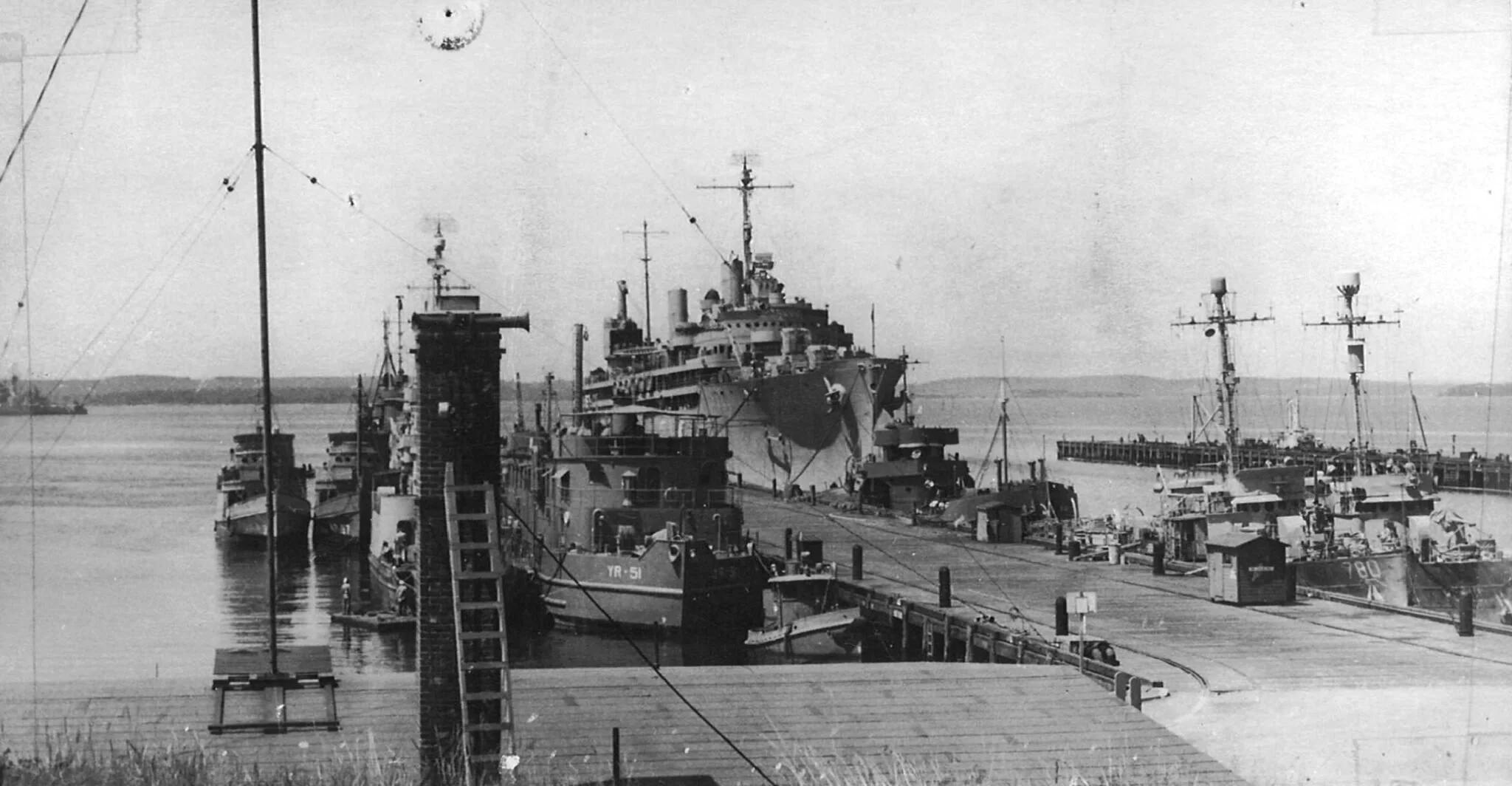
Vessels berthed at one of the Long Island navy wharves (courtesy national archives collection). This story here.
RICHARD’S STORY GOT me thinking about all the other ways military power and fishing overlap, and how, in some ways, I’ve followed this overlap around the continent, studying the different patterns of marine use.
With that in mind, I figured this could be a good blog to finally introduce myself a little bit better. I want to explain why I think about fisheries the way that I do. I tried to shrink this down to a manageable size, but I think Phippsburg’s fishing story is part and parcel of a much larger history. To do it justice, I might as well dig into the details of why I go on (and on) about fish, money and the people caught in between. Because it’s going to be a lengthy old ramble, I thought I’d break this blog into three parts. The rest of this first part will take us way out of Phippsburg, even out of Maine.
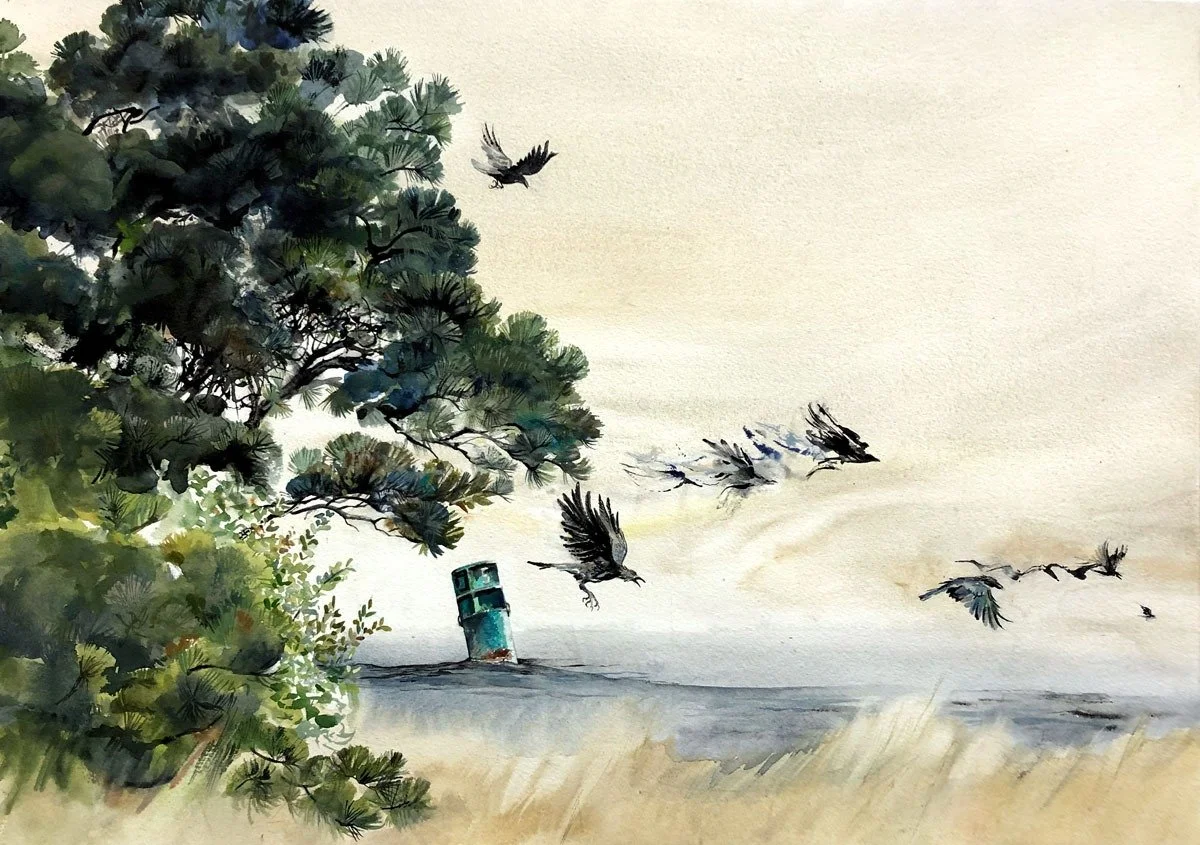
A watercolor from my dad: Popham’s familiar buoy marks a federal navigation channel–down which BIW-built warships run.
I GREW UP in a little city called Hallowell, a ways inland on the Kennebec River. But my dad, actually, spent his early years in Phippsburg Village. Craig Chapin taught his sisters. His paintings often showcase Phippsburg and Popham. One such piece, depicting a federal navigation buoy, can be found here. At a recent book club meeting, Jean Flink very kindly offered to give me one that she bought years ago at a Popham art show. In Spring Tea, my dad painted me toddling about our Hallowell yard.
At the University of New Hampshire, I studied biology, mistakenly assuming the study of the biological world was as straightforward as the pursuit of the arts seemed tangled. After, I moved out west, looking for bigger mountains and wilder trails than the east coast could offer. Eventually I found myself up in Alaska, working at remote salmon hatcheries. I loved this work and felt really at home on the water, in a way I hadn’t yet felt. This sensation of homecoming is, perhaps, part of why I advocate for small-scale fisheries so ardently.
After a couple years, chasing a bigger paycheck and general adventure, I started working on the big fishing vessels of the Bering Sea and Gulf of Alaska. Our port, Dutch Harbor, shared land and water with the islands of Amaknak and Unalaska. Dutch Harbor is the most significant trading port in the North Pacific. Hundreds of cargo ships and fishing vessels move through the harbor every day.
My first contract in that position was for three months. My company placed me on a big, 100-person pollock factory vessel, the F/T Pacific Glacier. In 2018 the pollock fishing was still pretty decent. Every eight days or so, we’d return for a 24-hour offload, meeting the longshoremen and forklifts who would receive the seemingly endless boxes of flash-frozen pollock fillets and surimi (AKA “imitation crab”). Then we’d load up on supplies and fuel before steaming back north to the fishing grounds.
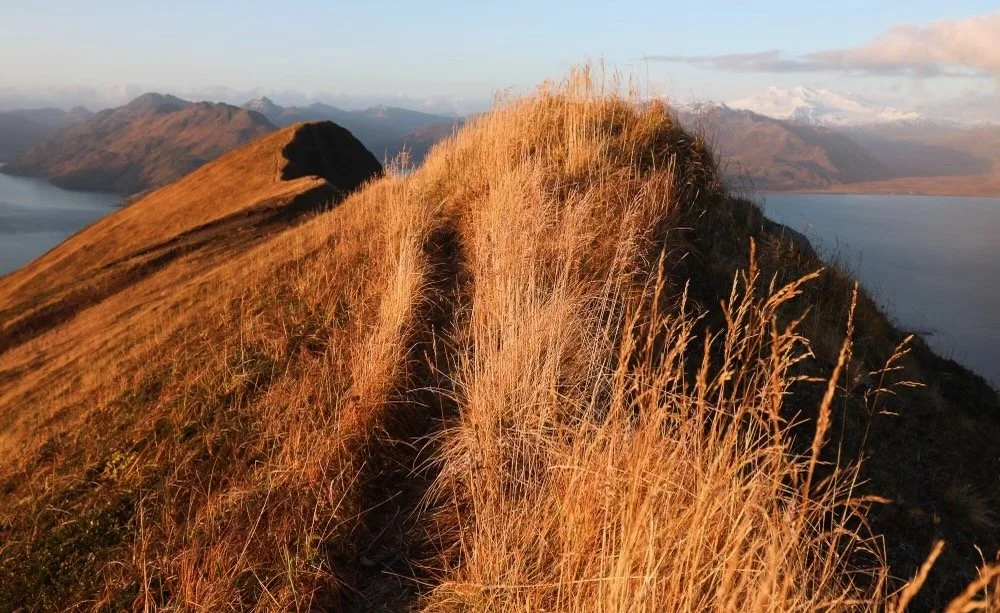
Ridgeline. Makushin Volcano in the distance.
UNALASKA’S WHOLE SWEEP is spiny with mountains. The Aleutian Islands are a volcanic, treeless chain. In fact, they’re the peaks of a submerged benthic range, born of a ring of deep sea vents between Russian and Alaska, that leak molten rock, known as “the Ring of Fire.” Fishing at night we’d sometimes see a volcano’s martian glow across the dark water.
On the grassy Aleutian scapes, you can hike for miles, hours, even days and not lose your bearings. The sea is always in sight. You can orient yourself by the intensity of wave action. To the south, the waves and wind are heavy. The north shores are better protected. This is, at times, a tough place to survive in. In other moments, however, it’s like a decadent–albeit cold–paradise. You can drink from streams, forage for a great diversity on land and from sea. It’s guttingly beautiful.
NINE THOUSAND YEARS ago, at the beginning of the Holocene, as the planet was warming a tad, Ungangan people followed these very resources down the Aleutians.
(Elsewhere in the world, some peoples who happened to live on arable land were gathering around agrarian centers, an ecological reaction that would lead, in part, to the formation of contemporary capitalism and our tendency to dramatically over-focus on mono-harvests and crops. Of course, not all cultures of arable lands followed this centralizing trend. Plenty maintained a balance of agriculture and wild harvest–including the Wabanaki.
There is no perfect way to exist on this planet, but man oh man does the contemporary mode of consistent overexploitation feel like a wrong way. If you know me, you know I’ll rant about this stuff. I’ll quit here, for now.)
On Unalaska Island, some of the slim trails, I was told, had been worn over thousands of years. Until and through the beginning of the arrival of Russian fur traders in the 18th century, the Unangax̂ had engaged in long-distance trade, swapping upland minerals for marine resources. Before the Russian arrival, Aleutian societies were already large and sprawling, with complex trade webs hyper-dependent on a balanced ecosystem.
During the 24-hour offloads, I was usually free to roam around, see friends if they were in port and hike the Aleutian hills as much as I could. Sometimes I’d wander nearly 20 miles. At that time, Unalaska had a year-round population of just over 1,000. Some of these were fish plant employees or fishing families, a few were folks who visited and never left, and many were Unangan people whose ancestors had been there for thousands of years.
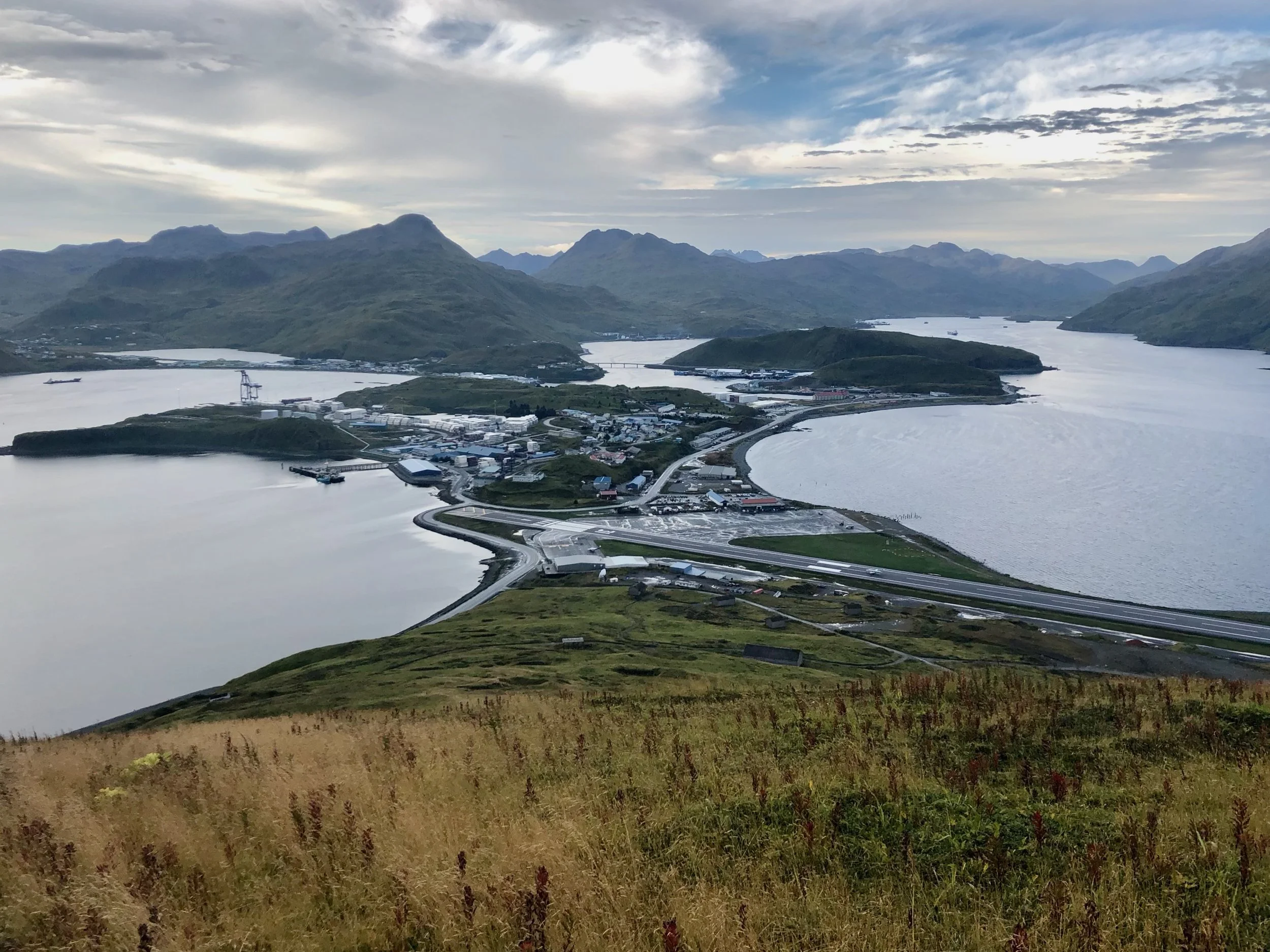
Port of Dutch Harbor, Tom Madsen Airport and Unalaska, seen from the slopes of Ballyhoo.
DEVELOPMENT HAS A way of obscuring the histories of different industrial eras. Residential development is no different. Here in Phippsburg, we’re immersed in that very obfuscation. As fishing wharves and family houses are bought by new owners, the diversity of historical use is hidden inside the homogenizing tendencies of new development.
Of course, this isn’t a new pattern, nor a pattern relegated to coastal communities. Take Maine’s old farmlands, for example, the small production of which was outcompeted by heavily-subsidized monocrops and mega-slaughter houses, or whose young workers were convinced by paychecks and false (and persisting) cultural narratives that city jobs were inherently “better” than rural jobs.
Those farmlands, once emptied of agricultural families, were prime spots for real-estate development. Subdivisions (the mono-crop version of housing) cropped up where veggies used to sprout. And those old farmhouses full of character were bought out–indeed, I grew up in one such house. My dad’s studio is on the second floor of a big barn, where hay used to be stored.

Trawler targeting pollock, in fine weather.
BUT OUT IN the Aleutians, residential development is sparse. It’s much easier to see evidence of the old industries and ways of life up there than it is in places of denser population.
Everyone who lives in Unalaska lives within the patterns of the working waterfront. It’s impossible to pretend otherwise–nor does it seem like anyone has much desire to. The economy is entirely formed on or impacted by industrial marine uses. Plenty of people still harvest and hunt some, though usually not all, of what they eat.
Unalaska is seventy-miles long and thirty across. Roaming about in those Aleutian hills, gobsmacked by the eerie beauty of that industrially-scored landscape juxtaposed with such planetary, unpeopled vastness, I began to sort out the material residues of now-extinct industries evidenced in the hillscapes. This was the first time I started wondering about the inverse relationship between ecology and economy with the broader question: How does boom-bust capitalism shape local culture? It was also the first time I started writing as a way to organize and deepen thoughts.
IN THE EIGHTEENTH century, Russian fur trappers arrived to the Aleutians on the flooding edge of global trade. They targeted mammals with lucrative pelts: foxes, sea-otters, beavers and seals. The trappers, or promyshlenniki, swiftly and radically changed the ecological landscape.
Like the Unangax̂, the Russian newcomers were part of a large, complex trade web. The problem was that the demand of distant consumers far outweighed the matching capacity of that Aleutian ecosystem. Eventually, other trapping companies, including American, arrived, increasing an unsupportable trend. This exploitation left the landscape and Unangan culture irrevocably changed. Today, in the small city of Unalaska, the green-steepled, white-sided Russian Orthodox Church overlooks Iliuliuk Bay. And on the summit of Ballyhoo, a small mountain ridge I’d often hike, a welded Russian Orthodox cross whistles in the constant wind. It’s quite beautiful.
The Norwegian Rat was introduced during this time and persists still, fed on pollock scrap and the eggs of vulnerable shore-nesting birds. On the thin-soiled, wind-scoured Aleutian rocks, the Russians tried to plant spruce forests for colonial fuel and ship-repair. Just a few thin trees remain today. In the years I was up there, I never went into that sparse copse. It felt wrong, somehow, a bit eerie.
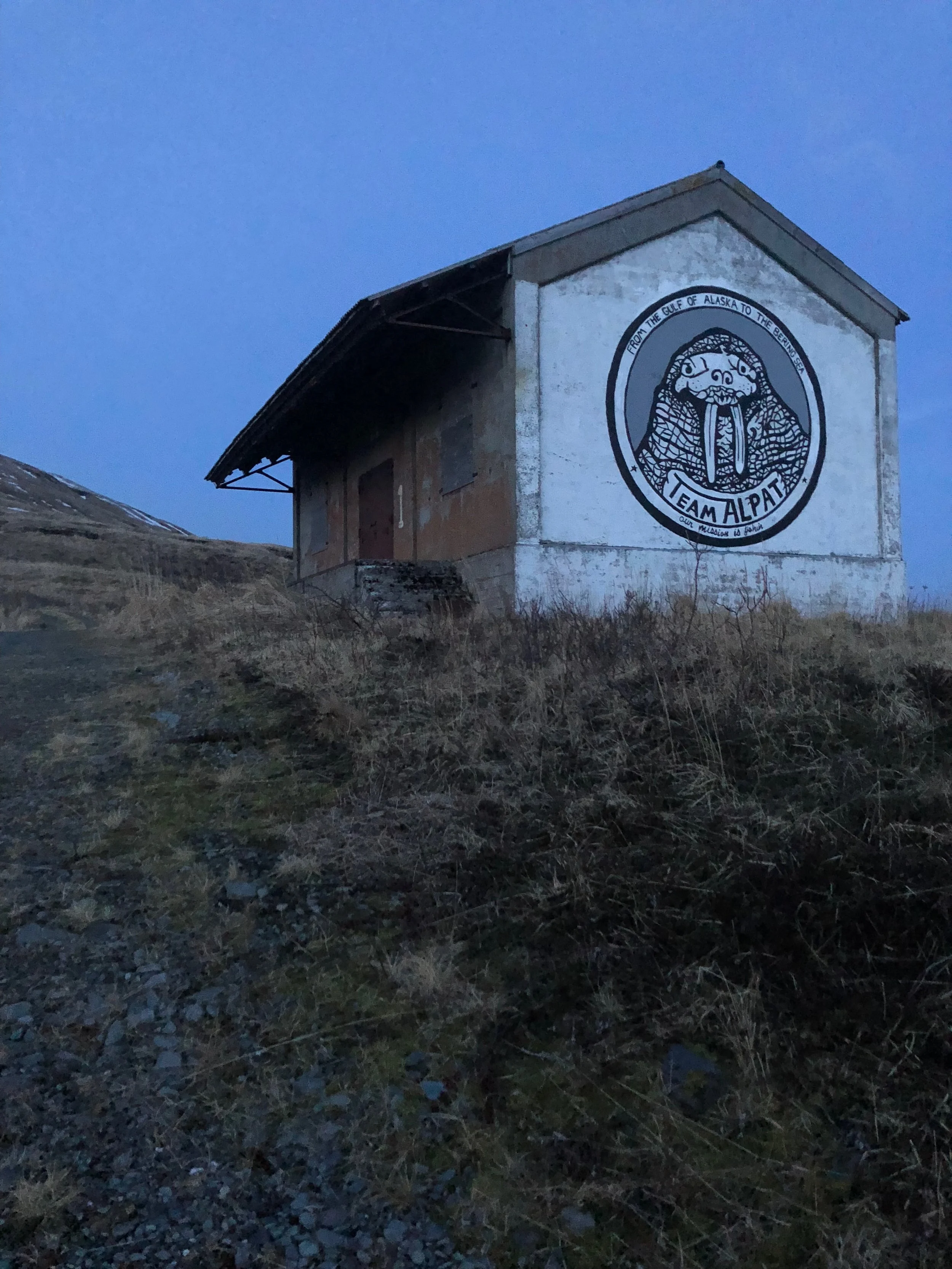
WWII remnant, painted with the Team Alpat logo.
DURING GRAD SCHOOL, I found funding to go back to the Aleutians. I spent the summer on land, chatting in community, and digging through the wonderfully uncharted mess that is the special collections of the Museum of the Aleutians. I read through translated transcripts from Russian Orthodox priests, American merchants’ journals, and anecdotes of profound Ungangan resistance to this sudden commercial onslaught.
The underlying narrative was familiar. Big-extraction’s centralizing force has a simple way of gouging ecological and cultural holes. These holes upset traditional, sustainable methods of harvest and create dependency on capital, a dependency just like that which drove the newcomers themselves to such extractive feats of greed. That dependency can look different in different places, cultures and levels of relative wealth. As an astute young student of mine at UVA once said, “Keeping up with the Joneses is how we all got so bad.”
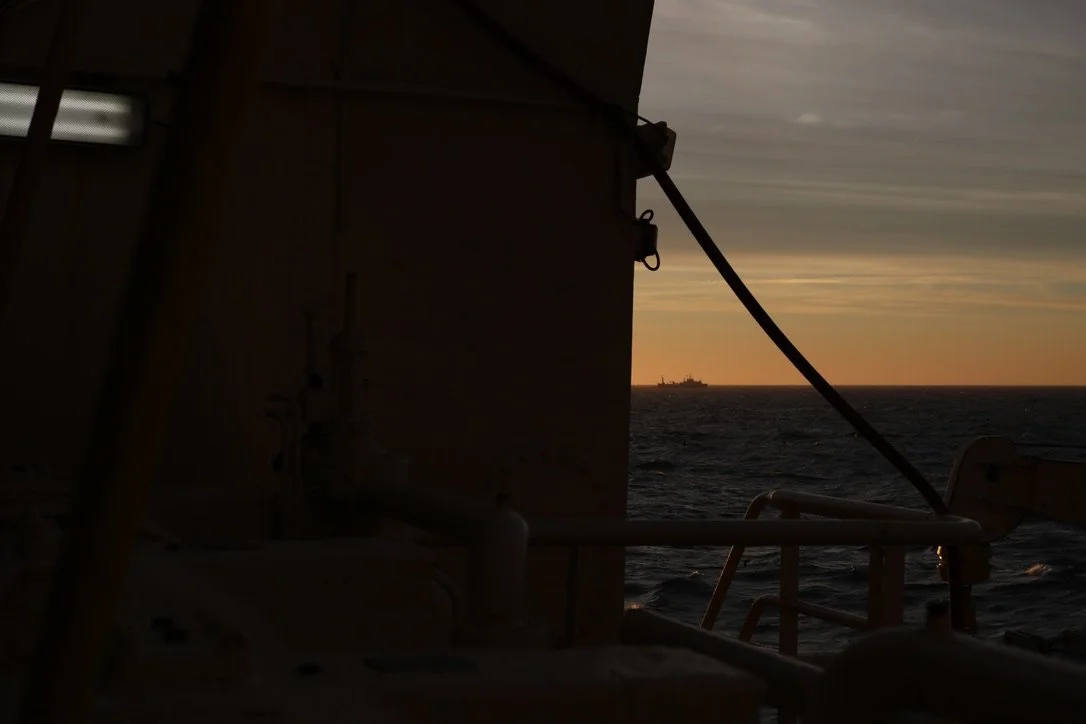
One in a fleet of many pollock vessels, on a calm day.
THE NEXT INDUSTRIAL wave whose historical remnants I hiked–and crawled–through, arrived with World War II. The US military built a base on Unalaska, transporting thousands of troops, nurses and support staff north. The military also forcefully relocated thousands of Unangan people.
Oral histories given by those who remembered this moment illustrate another intensely traumatic moment. Those testimonies can be found at The Beginning of Memory Project. Ten-percent of those relocated died in the swampy, isolated encampments they were relocated to. Many survivors were never able or legally allowed to return to their homes.
Evidence of that military presence is clear. Gun turrets, caves and tunnels dug for ammunition, cement latrines grown over by grasses, signs cautioning against unexploded ordnances: After a while, all of these seem ordinary, part of the landscape.
AT THE TIME, of course, I was living and working within another major boom of industry: commercial fishing. I began to wonder: What would happen to the landscape if fishing failed?
Industrial activity is a 24/7, year-round constant in Unalaska. Eighteen-wheelers haul processed fish from shoreside processing plants on Captain’s Bay to massive cargo vessels in Dutch Harbor. Fishing vessels arrive at all hours, requiring longshoremen to catch lines, forklift drivers to receive and stack lofty pallets of fish, flash-frozen at sea.
Consumables arrive from over the global ecosystem: Charmin Ultra Soft Smooth Tear, Kellogg's Rice Crispies, Dawn Dish Soap, Shell Oil, Costco Couches, Michelin tires, Bud Light, marine supplies to stock the shelves of Trident-owned LFS, Victorinox knives, Land o’ Lakes butter. These products arrive on pallets, just like the processed fish that will be sent out into the ether, swaddled in heavy-duty plastic wrap, and packaged with their familiar branding.
The F/T Pacific Glacier (since bought out and renamed) was a fairly swanky, 100-person pollock vessel. Indeed, it was, out of the nearly 20 other vessels I would work on out there, the cushiest. It had been fishing since the eighties, when the Bering Sea pollock fishery, due to sudden increases in fishing technology and heavy international fishing pressure, was booming. In the nineties, following the nigh-eradication of a significant pollock population, the Bering Sea pollock fishery would reorganize itself with new management strategies. For a while, this reorganization felt like the answer. Pollock could be fished–and fished at ludicrous levels–forever.
JUST OVER TWO decades later, however, I thought it seemed pretty obvious that it couldn’t be. Like most big pollock fisher/processors out there, the Pacific Glacier could and did haul in 200-ton bags of pollock–sometimes every five hours.
On deck, and especially at night, I could often look out and see a galaxy of other vessels, dragging their immense codends (the end of the net in which caught fish collect) through the same population of pollock.
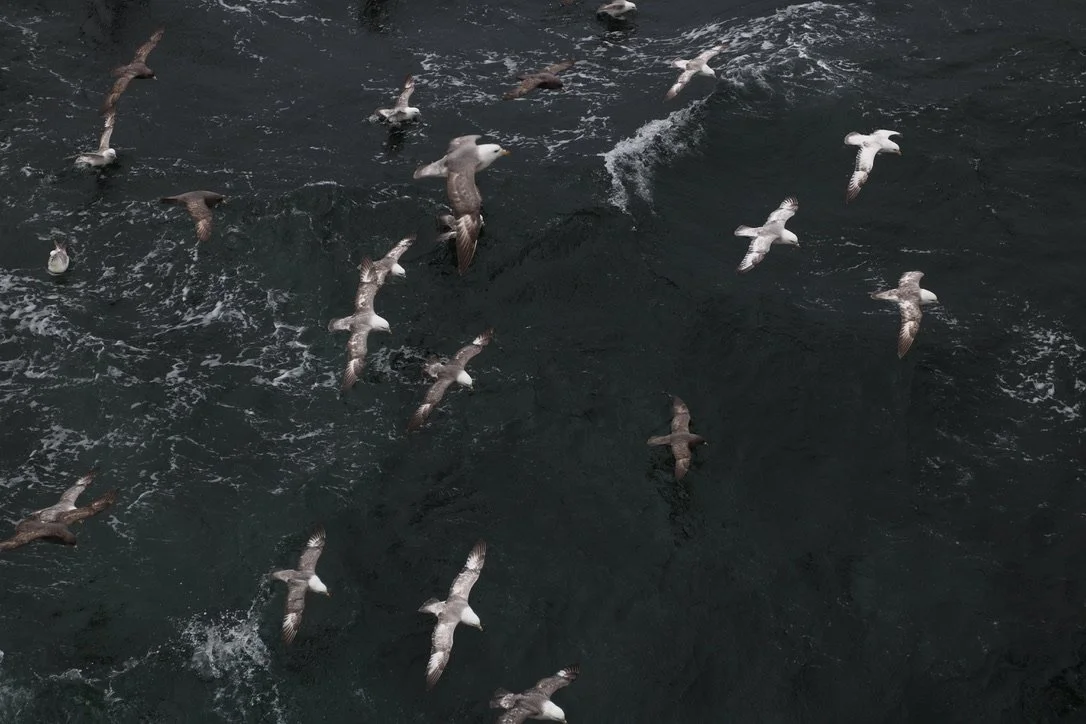
A captain on Pacific Glacier once said to me, while I was collecting logbook coordinates in the wheelhouse, “The fulmars are feeding on the blood of the pollock.”
With the impending sale of the vessel, he was facing a forced early retirement. Nearly a decade later, that sentence still strikes me as uncanny, poetic. We were 100-feet or more above the water, looking down at the ever-constant whirlwind of fulmars, kittiwakes, albatross and other sea birds diving into the bloody froth that the factory created and purged through the sump pumps. I still don’t know what he meant, but there was something like an incredible sadness in how he said it. Every trip took us further north.
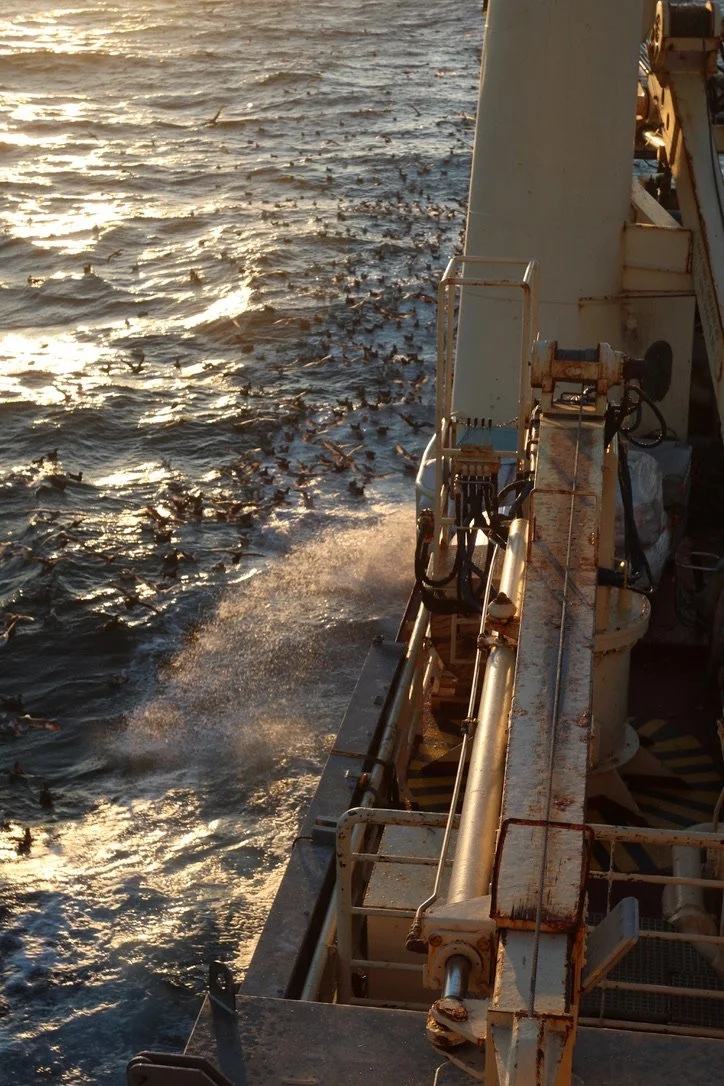
Storm of seabirds feeding in the bycatch. Even a multi-day steam offshore, the birds follow the boats.
NOW, NEARLY A decade later, friends who still work up there say that pollock boats are losing money, chasing the fish ever north. Boats are also fishing much longer into the season, as opposed to hitting their quota within a few months. “They’re just scraping bottom,” one friend told me.
As a fleeting visitor to the Aleutians, who spent most of her time on the sea, I only got snapshots of this history. And as I am here in Phippsburg, I was ever-conscious of my identity as an outsider. I understood that the story of the Aleutians in isolation was not mine to tell. Instead, I needed to keep learning about high-latitude fisheries, to understand how it all fits in one, big picture.
The lines we strike between ecosystems are imaginary. To me, writing about Phippsburg’s fisheries feels like writing about the patterns of all fishing communities. They have more to do with our faulty ability to conceive of different time scales. That is, everything is in flux, even if that flux is not obvious to our puny human scope.
I’ll send out the second part of this blog in a few days. In it, I’ll get a little closer to home, talking about the North Atlantic cod fishery–one that many of us have ancestral, if not personal, ties to.
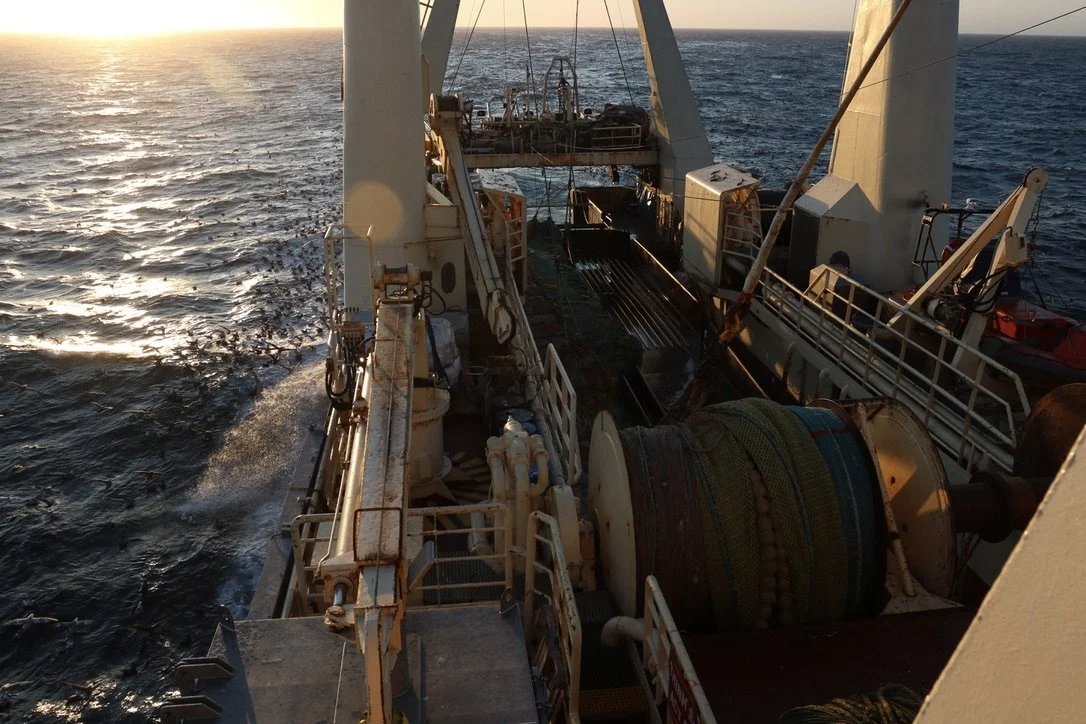
In that job, I had to sign a contract stating that I wouldn’t take or post photos, if I remember correctly, of full nets or factories.