Algorithmic Hurdles
Part 1: On the “Tyranny of Algorithms” in a Mudflat
“Mathematical language, like the world of language and that of writing, actually seeks to make the territory resemble the map.” — Miguel Benasayag, The Tyranny of Algorithms: Freedom, Democracy, and the Challenge of AI
This will be another quite lengthy blog. I’ll be talking a bit about how mudflats are regulated here in Phippsburg and the friction that algorithmic ecological management can cause.
WEATHER PASSES OVER a mudflat. Some mudflats, like that of Atkins Bay, are wide open to the sky. Some, like the upper reaches of the Basin, have treed ceilings in summer. The trees lean over you there. It’s warm now. There’s baitfish running the last few days. Terns storm and dive in the receding tide. If I’m listening right, I hear Troy and Casey and John and Terry on the far side, digging. They are all clam diggers, or wild shellfish harvesters, depending on who’s talking, and are part of the larger, subtler community of diggers in Phippsburg. I am not a clam digger, though I am beginning to think that I would like to be more of one. I recognize in its patterned motions the sensations of running and writing and harvesting a garden row.
Terry Watson and I talk often on the flats, in various types of weather. Mudflats are great meeting spaces, these big living floors beneath sky. You are meeting and talking while in meditative motion. Are you a runner? Or a painter? Do you sew or garden or do yoga or sail? What in your life allows you the sensation of an embodied knowledge gathering in your joints and fingers?
While digging, the body learns. Your hands weigh the heft of the animal and your eyes gauge sun and shadow and beauty. You feel the certain suck of the mud on your booted foot through your knee and hip joints. The clock of your body keeps an eye on the tide. Birds cry. Beyond the treed ridge of Fort Baldwin, the edge of the Atlantic flops over. Perhaps this makes it all sound very busy and loud, as though Terry and I are having these meetings in the Maine State Music Theater or on the stairs to the subway. It’s not like that. Not noisy at all.
It’s like going for a walk with a friend who also likes walking and thinking. A mudflat is a good place to think. Terry goes out there to think. And when I join him, we often talk about these things, these thoughts, and how it is to ponder the shoreside stuff like this, while in motion. How good it is for the mind. It’s funny, we reflected recently, how we say often that this work of digging is so meditative, as though to be at peace while working is odd. But in the history of humanity, weren’t most of our obligations, so often revolving around food gathering and hand crafts and home building and wood chopping and foot borne travel more akin to digging than they are to say, consulting or sales or book publishing? Wasn’t a vast chunk of knowledge housed in the body? Likely, it is still: I feel my lower tense up, telling me it's time to get up from the computer.
This is not to say that digging and its analogs are easy or the stuff of dreamy vacations. They’re not. But they require a different kind of thinking, seeing and feeling. And they’re about food harvesting. Which is, at the beginning and the end of the day, as we break fasts and begin them, a most fundamentally human joy. I fell so in love with water work a decade ago because of these things. There was time to follow a thought to its end.
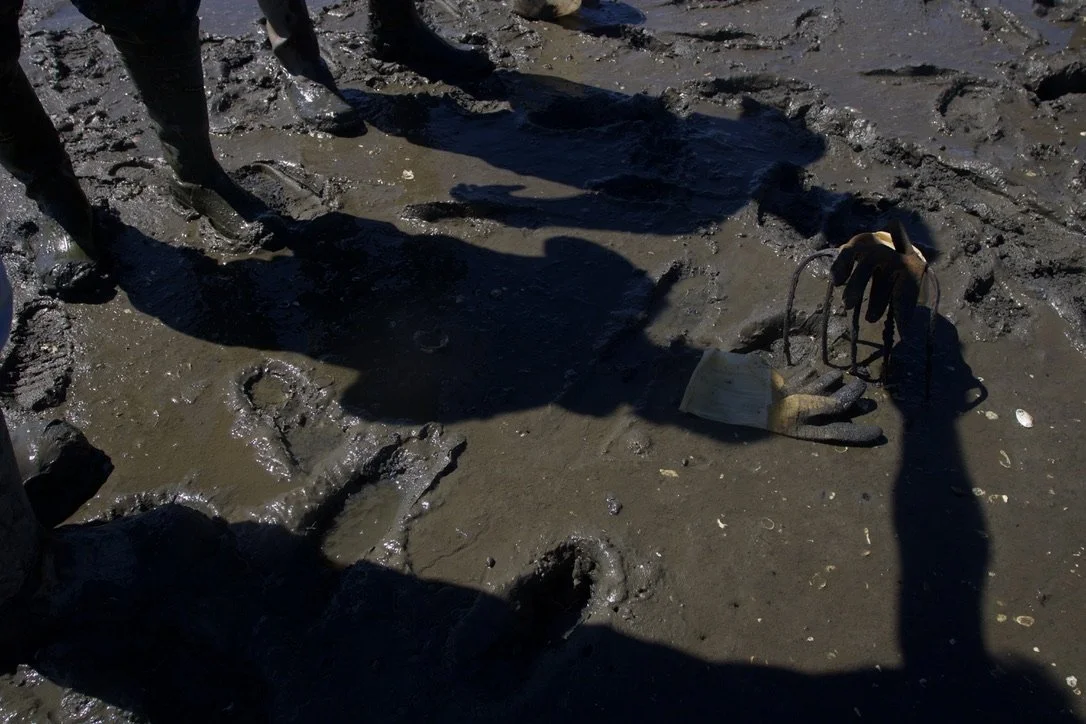
A WHILE AGO now – I’m belated in working on this – Terry suggested that I write about why fishermen think in the way that they do. “How do you mean?” I asked. We were digging out in Atkins. He was showing me how to flip the mud depending on the depth and size and visibility of the clams. And whoosh, like a magic trick, when I followed his instructions, there they were, these small animals, and the damp, darker seeps of their breathing holes.
“Out here is real,” he has said on numerous occasions, and in various ways. How the tide moves and keeps time is different and mightier than how a clock ticks. A digger’s brain and thoughts adapt to these rhythms, Terry said, just as the 9-5 clock, say, shapes a life.
But the way diggers work, Terry continued that day, is managed by a set of numbers. The numbers are based on a few easily measurable qualities of the mudflat. And these numbers are a tool for the people at the Maine Department of Marine Resources (DMR) to manage the mudflat – or, more precisely, to manage the harvesters on the mudflat.
With these numbers, it is easier to manage mostly from a distance. Like many state departments, the DMR has ever-more limited resources. We live in a time, however, when greater capacity is needed daily to deal with all the changes, growths, and failures of this blue economy in which we human shore-dwellers live and participate. It’s a tough spot for everyone. The algorithm streamlines management for the overworked DMR employees.
For clammers, however, Terry says that this ecological management system results in a sense that they live and work in a jarring overlap between reality and a numerical fiction.
This management style is sort of like a secondary weather system, that of numbers. You cannot control it, and yet, there it is, a cloud that seems to be sent from far away, shaping your day and livelihood, which, when you ask it to explain itself, doesn’t often talk back.
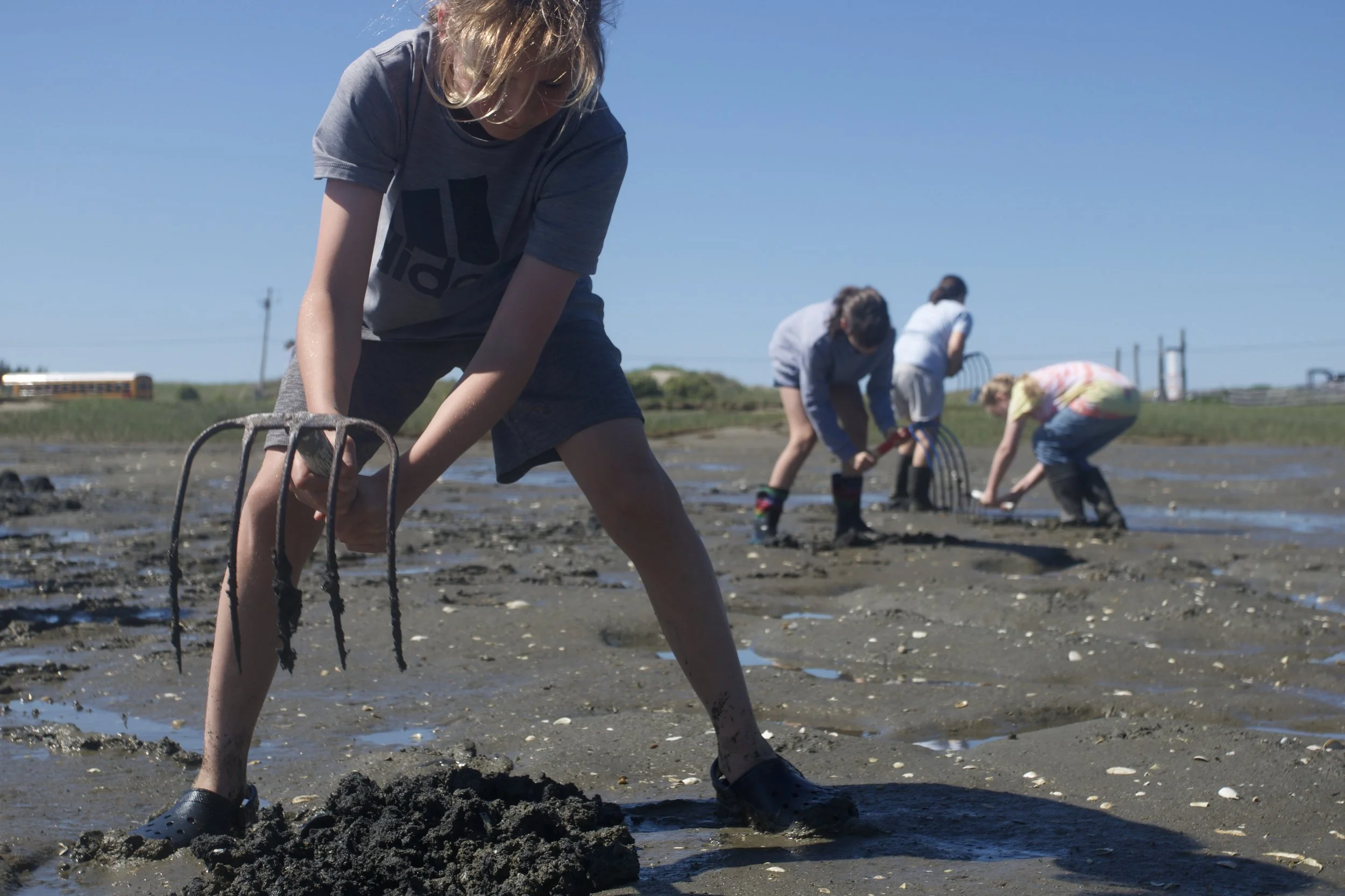
Young kids wielding harvesting tools (with supreme confidence.)
TERRY AND CASEY Watson, David Gray (Phippsburg Shellfish Commission Chair) and even the DMR folks have taught me a lot about wild shellfish management. There are certain bits I still don’t quite understand, but I’ll do my best to summarize it here.
The DMR can open and close mudflats to harvesting based on particular water-quality parameters. Much of the harvesting management of Phippsburg’s eastern flats is subject to the flow rate of the Kennebec River – a separate problem of numbers I’ll dig into in a later blog. But other harvesting areas are also monitored by standardized microbial testing. If levels of fecal coliform in the mudflat are too high, the mudflat closes, protecting not only the consumer, but the integrity of the industry. This makes sense.
Microbial levels are measured with water-quality samples. That means that somebody from the DMR has to get down into the mudflat in question and collect those samples. There are specific sampling sites in each mudflat, representing both the near-shore inputs like streams and the thickest harvesting area. Those samples are then taken back to the state lab to test for microbial organisms. This is an ongoing process. The resulting microbial data points are then incorporated into a formula. This formula is continuous, holding 30 scores – about five years worth of data.
As new scores are incorporated, the older scores from five years ago are shed. If there is an outrageously high score, or outlier, this will likely be removed from the calculation. The resulting number is called a P90 score and means that 90% of the water samples are at or below the resulting score. If the score is too high, the mudflat closes.
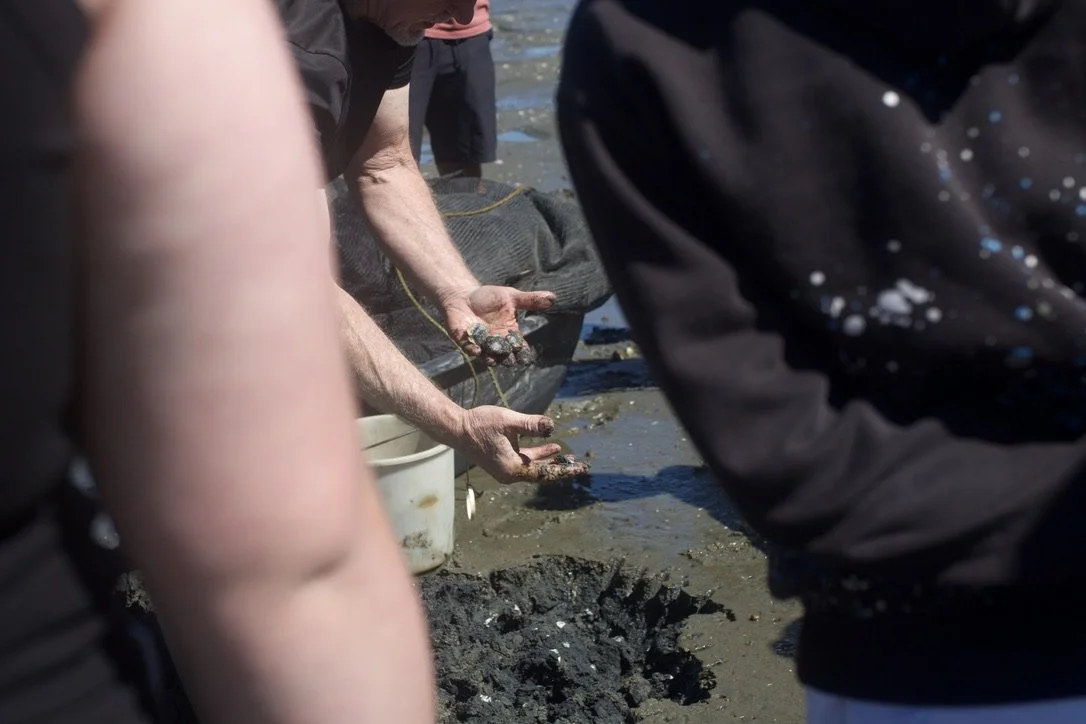
Terry Watson teaches the kids about clam growth patterns and digging techniques.
THIS MANAGEMENT PRACTICE makes some sense, right? The operating budget of the DMR is limited and resource management hurdles keep growing. I have a couple friends at the DMR. They always seem to be performing a gritty juggling act. But they are passionate and they are overworked and maybe they’re a little underloved. Most of the time, it seems that people are executing their job just as they’ve been told, operating within the system into which they’ve been placed.
I get the sense, however, that there’s a real discomfort that can arise, as DMR employees hear the repeated frustrations of harvesters and yet can do little to change the system. I bet that pressure is a heavy load.
But on the flip side of things, it seems that not everyone acknowledges the harvesters’ frustration as legitimate. Because when they do acknowledge this, it’s a big deal for the harvesters on the receiving end. Recently, a DMR employee was in Phippsburg. He didn’t change the system. He didn’t decry the DMR or its policies. But as folks were talking about the frustrations caused by prolonged closures, he did say: I hear you and I understand this is a pain-point and I can’t change the system, but I can advocate for you.
It was a simple moment. But it felt big, somehow. I felt like I’d witnessed a more balanced dialogue – something that many harvesters, not just clam diggers, feel like is lacking in management practices.
FOR EXAMPLE, HERE’S a hypothetical problem that rises with inflexible algorithmic management practices like the P90 system:
Let’s say that in three months, in August 2026, several microbial scores read quite high but not so high as to be considered outliers. Therefore, they are incorporated into the managerial formula, causing the closure of an important mudflat.
The diggers are notified of this closure. If they typically harvested from this mudflat, they’ll have to reorient. Certainly, a bit of reorientation is part of the work of any harvest. Weather comes in. Knees need surgery. A cancer radiation schedule is indifferent to the tides. Markets slump. Too much chronic reorientation, however, is not logistically or economically easy.
But let’s also say that the harvesters have an idea of the source of the sudden microbial surge. So they reach out to the DMR and say: Hey, we think that was an anomalous event. We think, in fact, the problem has sailed away. Can you come retest this water, gather cleaner scores, reopen the flat and let us work? The DMR will likely respond: Hey, so sorry, but we don’t have the time or budget to do this. All we can do is retest at the scheduled date. And hope the scores go lower then.
Can you imagine? Seriously. Can you imagine the frustration that this would cause you, if you were subjected to this sort of inflexible dismissal? Imagine you’re continuously advocating for yourself, saying: Hey, I am the best and most intimate witness of my environment. I feel, therefore, that I should be treated like an authority in its management. But you are increasingly met with a formulaic response, if not an outright sense that you are thought of as some sort of perpetrator, as if the fluctuations were your fault. Can you imagine the weight of that frustration?
Of course, let me reiterate: Everyone, even the DMR employees, are working within the confines of a system that seems quite difficult to change.
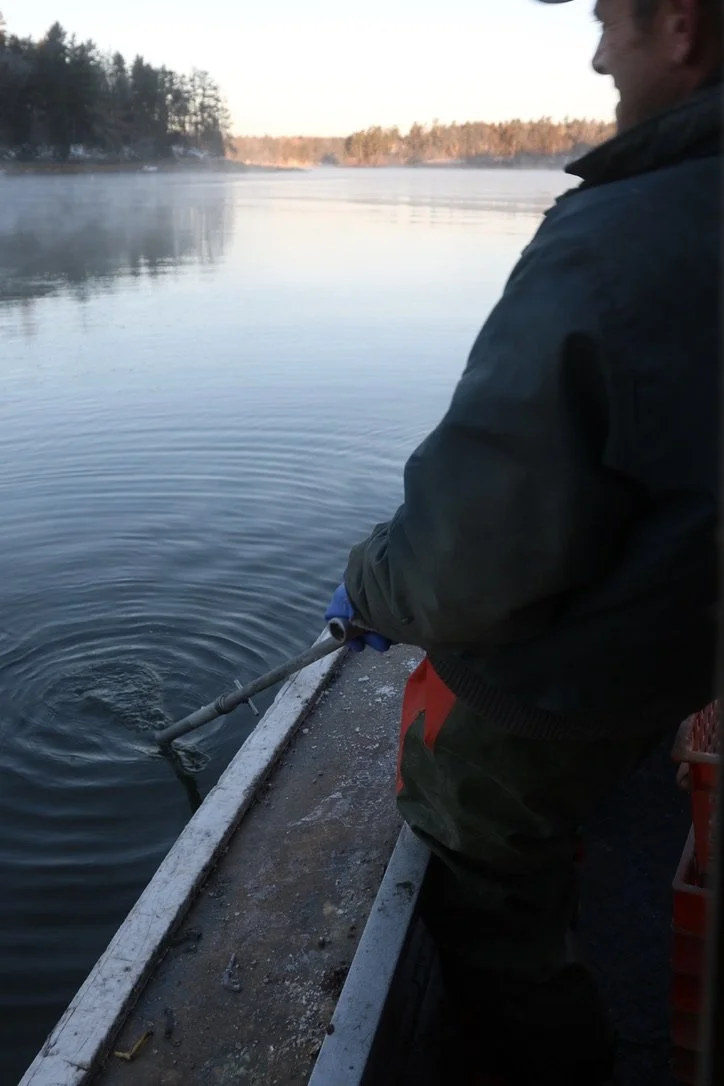
Dan Watson harvesting quahogs last fall.
THESE SORT OF SYSTEMATIC problems get me ruminating on weather.
For some of us, the working clock goes around in a circle and – absurdly – does not change its speed for seasons or rainfall or lightning or a good afternoon of sun. Food comes from somewhere else. Money is a product of abstracted motion, keyboard strikes, phone calls. But for people who make their living on the water these statements are less true. The diurnal working clock is measured by strings of traps or bushels or tides. Food comes through their hands. The money is of a material product, sold to the familiar dealer at the water’s edge.
But we do all live, to some degree, in the weather. And the weather we experience is of large and largely uncontrollable systems. All we can do, no matter how foul or fine, is wait – or brace – for it to change. And nobody causes weather, right? But of course, we do collectively change the weather, because we’ve been born into an era of an environmentally-harmful social system.
In some ways, we’re no different or more powerful in this regard than bacteria. Billions of years ago, the wee but ubiquitous cyanobacteria burst into existence, and began burping oxygen. Atmospheric oxygen levels soared, fundamentally changing all other life systems on earth.
(Did you know that there is such a thing as aeroplankton? These are tiny organisms, just like those floating in the water columns, that drift about in the weather systems. Sterility truly is an odd, and only occasionally useful, human invention.)
BACK ON SOLID earth, however, in the mudflats, bacteria levels rise and fall for all sorts of reasons. Changes in stream ecology and flood events can drain upriver microbes into the intertidal. Migrating birds or domesticated dogs might have an impact.
In Phippsburg’s steamy summer months, as we crowd on the shorelines, recreational boating surges. The frequency of overboard discharge also increases. And some waterfront properties have faulty, outdated wastewater systems, or even have a “grandfathered-in” right to dump untreated wastewater. There’s a whole lot at play in the bacterial ecosystem – much of which is beyond our current capacity to measure.
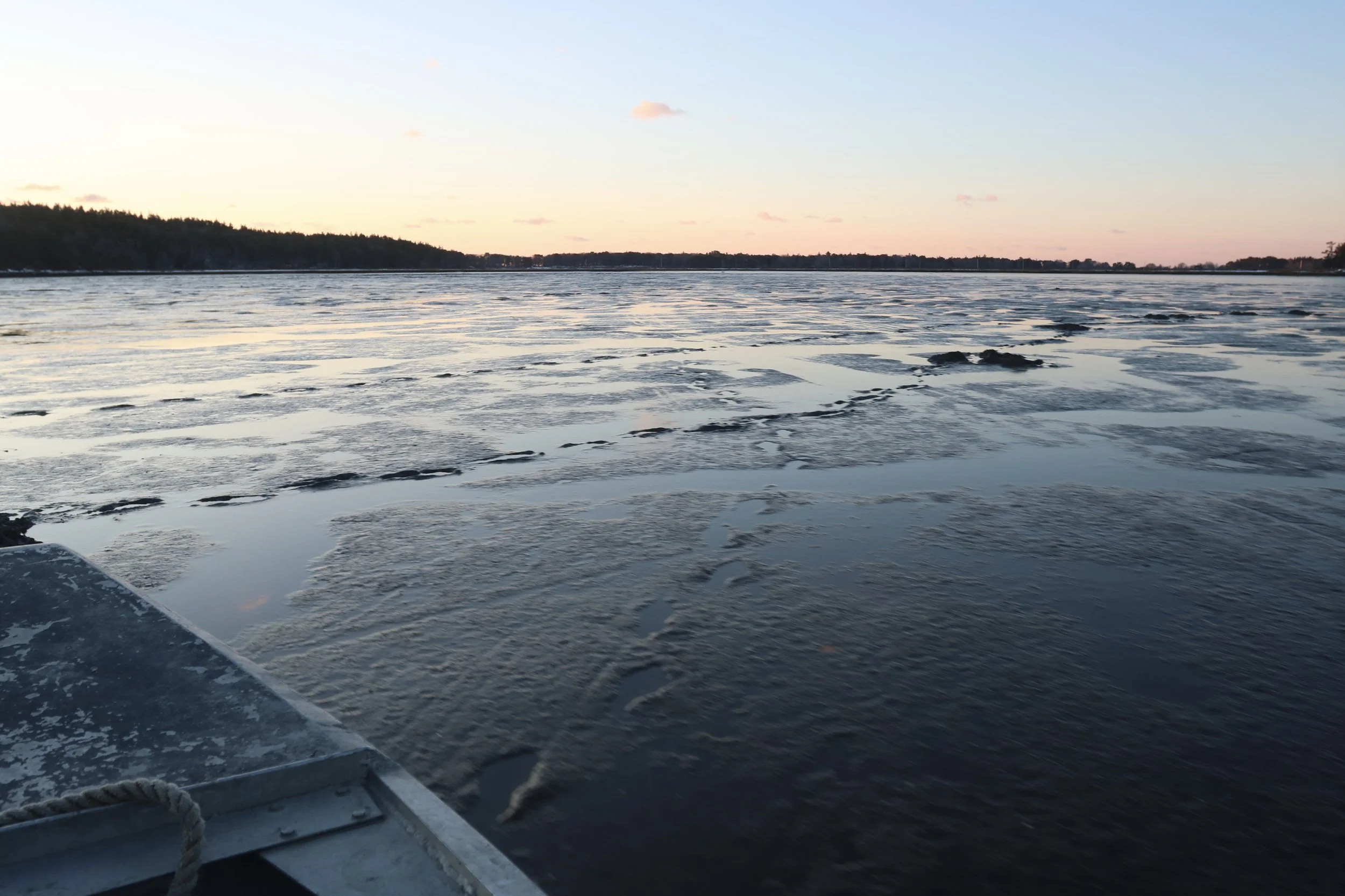
People don’t quit eating clams over the winter. Some diggers don’t quit digging.
BUT IMAGINE YOU’RE a clam digger. And then, imagine that you, who are outside and witnessing the intertidal ecosystem and its tangled relationships every day, notice a correlation between microbial surge and certain new variables, as, say, a flock of geese or gaggle of pretty sailboats or the arrival of short-term renters.
You know that your workspace and life and livelihood are about to be impacted. By which I mean, those P90 scores are about to leap.
But instead of solving the problem at the source, it seems like the powers that be simply say: You can’t dig here anymore.
In short, maybe it feels like you’re being punished for something somebody else is doing. Maybe it feels like everybody who knows anything about this system knows that this is precisely what’s happening, but nobody thinks it is – or you are – worthwhile enough to waste resources on finding and fixing the actual problem.
Of course, I’m being a little reductive, and perhaps a tad inflammatory. Management and environmental scientists do incorporate harvester’s voices. The lobster zone councils are set up with a harvesters-as-managers mentality, the state Shellfish Advisory Council is a quarterly meeting of intertidal leaders, and plenty of scientists and coastal nonprofits are leaning ever more heavily on community-engaged work to inform their research.
But there is a constant refrain: Harvesters, those people who are most intimate with the changing details of an ecosystem, say they feel unheard too often. I’m not really sure what the solution is. It may well be that before a tangible solution can be found, the cultural norms that underlie management practices first need to change.
What do you do if someone doesn’t hear you? Do you raise your voice and try again? Or do you put your down and try to work within a system that seems perpetually faulty? Harvesters take both routes. It takes time and energy to raise your voice and advocate for yourself. Terry has been showing up at the legislature and sitting on all sorts of councils since he was eighteen, five decades ago. He talks lately about being depleted. That makes sense. This spring, he’s been digging through cancer radiation. But I know he also means that these five decades of trying to shout loud enough to get heard are tiring.
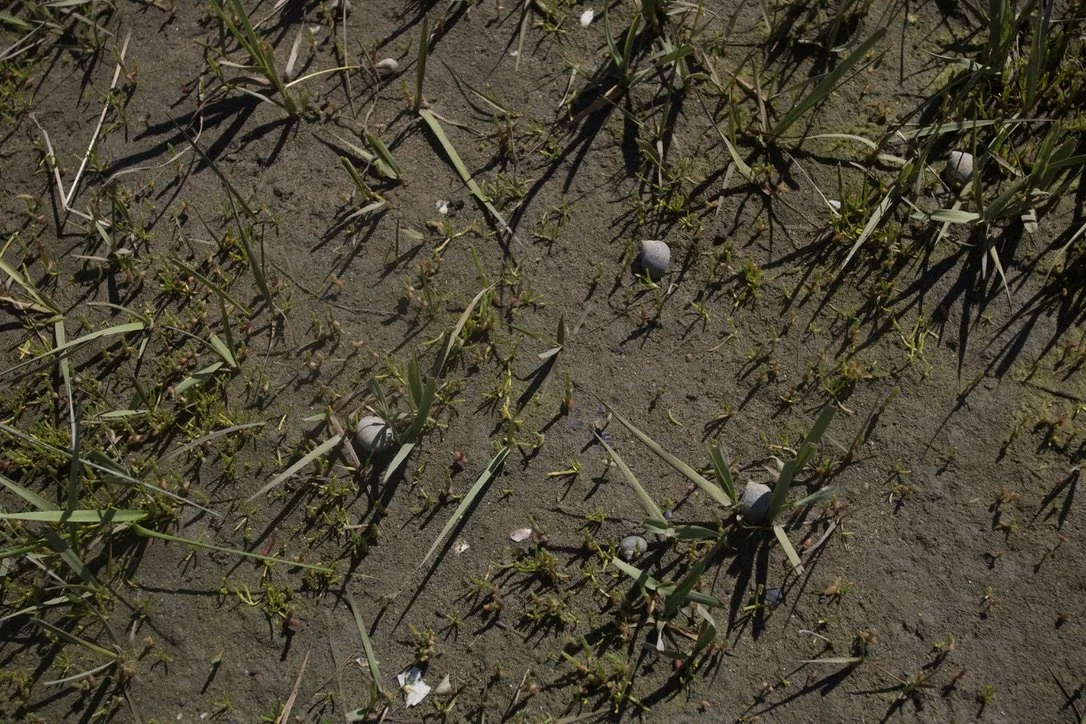
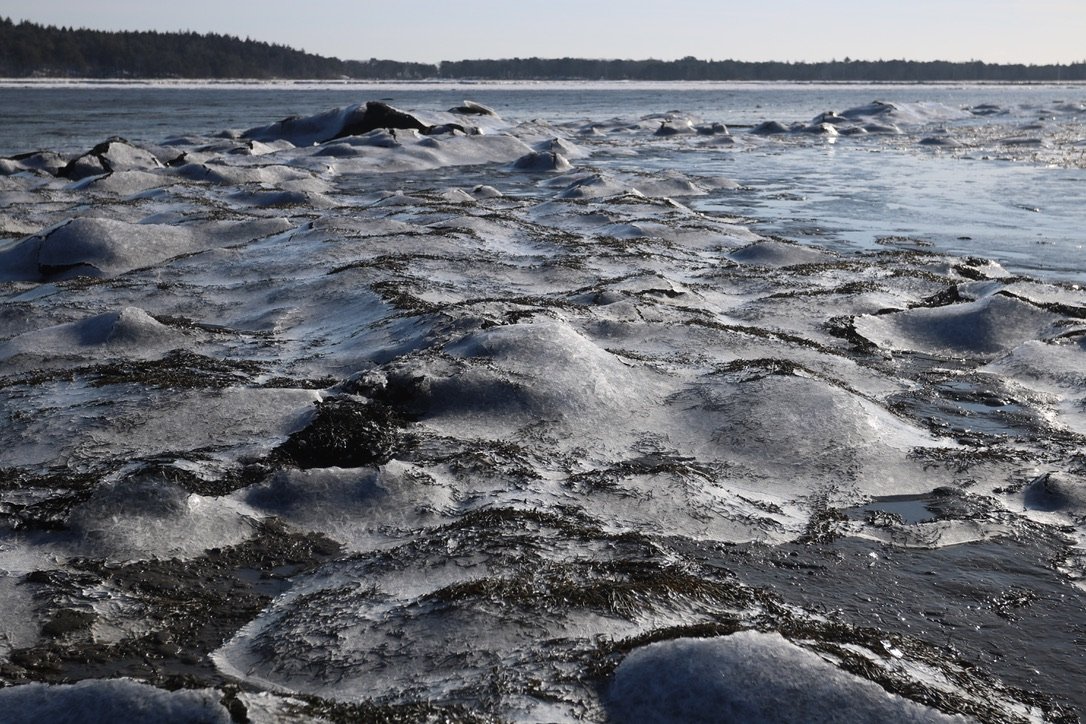
The driest edge of a mudflat. When stuck in the mire of overlapping contentions, I can be a little gobsmacked when I remember that everybody shares each tiny detail of this global ecosystem. Sharing, of course, isn’t always equitable or easy. Nevertheless, periwinkles and scrub grass are under everybody’s feet.
OF COURSE, THE DMR folks talk about feeling unheard, too. They talk about a powerless that feels quite similar to that of the harvesters.
But there’s a real difference here.
If you’re paid by the hour or salaried and get some sort of health care (albeit potentially shoddy), not feeling listened to might be awkward, frustrating, uncomfortable – and sure, might make you feel doubly powerless – but you’re still getting a paycheck.
On the other hand, if you’re a clam digger and the people who don’t seem to be listening are the spokespeople and earpieces of the system that is hindering your capacity to make a living, then yeah, that frustration means something else.
This systematic stuckness is sort of like weather. While everybody has to worry about a rainstorm, the impact that rainstorm has on people’s lives is wildly imbalanced.
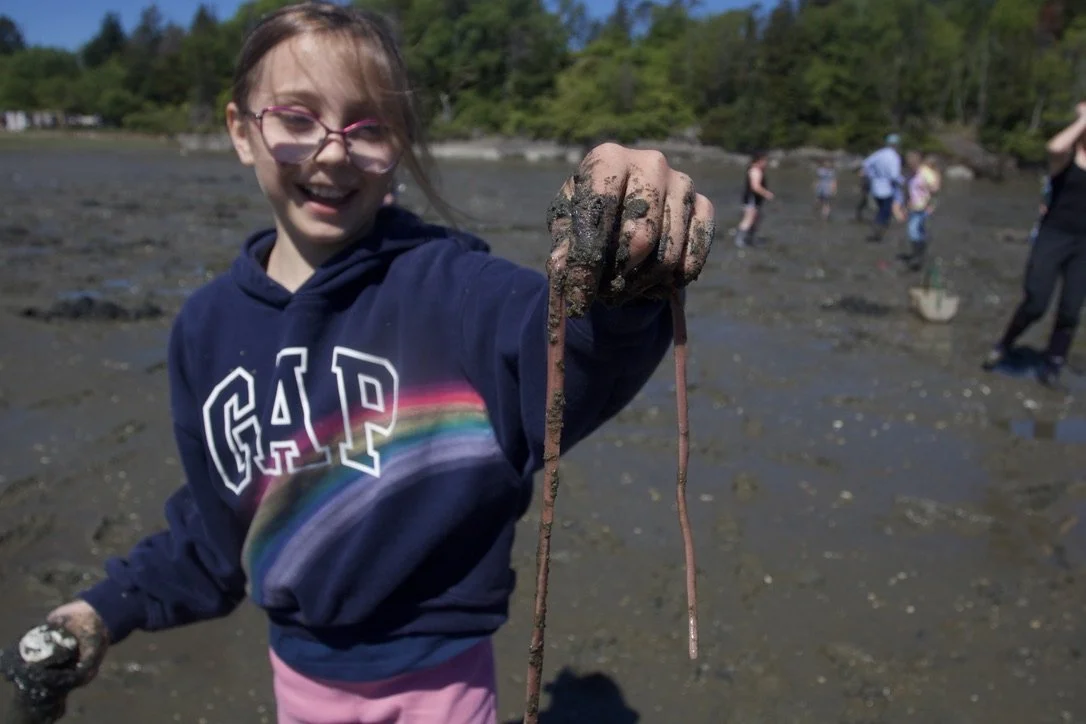
A young student showing off her new pet milky ribbon worm, dubbed “Bloody.”
FOR A WHILE, the intertidal areas around Sebasco Resort were permanently closed. This is because Sebasco Resort had an overboard discharge system (OBD) for its wastewater. Recently, the OBD was replaced with an engineered subservice disposal system – essentially, a septic system that is designed specifically for this tricky area. This means that the DMR could test and consequently reclassify the intertidal areas historically impacted by Sebasco’s waste as “approved” or “conditionally approved” for harvesting.
This is a win. But these sort of wins are slow-moving and often take resources and time to make happen. It’s also sometimes tricky to isolate the exact source of the bacteria surge.
Manomet Conservation Sciences is leading an effort in the Basin to address some of these challenges. This summer, Manomet will pay the DMR to increase its watersampling in the Basin. Marissa McMahan (Senior Director of Fisheries) notes that this is the “first step” in a broader microbial source tracking (MST) initiative. Or, more simply, the first step in getting a better sense of why bacteria levels surge in certain months and in certain areas. In MST, the bacteria collected in the water sample is amplified until the genetic material is ample enough to test. Basically, this MST asks: Did this come from humans, geese, domesticated dogs, or something entirely unthought of?
SOCIO-LEGAL SCHOLAR DAVID Whyte, in his subtly titled Ecocide: Kill the Corporation Before it Kills Us, discusses how resource regulation often targets the lowest-hanging fruit. He posits an imaginary future when industrial-corporate ecocide (the incidental ecological tragedies that too often occur when large businesses wreck the ecosystems they are squatting in) is not only punishable by law, but is punished.
As it stands now, Whyte says, regulatory controls always choose the “least invasive point at which to intervene in the industrial cycle… most industrial processes are controlled at the end-point.” In short – ecological management controls the little guy and hopes somebody else will tackle the big perps.
In the context of our local watersheds, one such end-point would be the people who harvest from the mudflats. That’s Troy and Terry and Casey and John, who are still now digging out in Atkins, and all the other diggers who live here in Phippsburg. As Whyte says, it’s way easier to control the 20-odd folks with the clam hoes than it is to control the large corporations upstream – or even the folks on land who might hold a tad more social currency in this unbalanced system.
Of course, I like Whyte’s imaginary future of ecological legal justice. But to hold corporations and people accountable – that is, to know for a fact that a large industry upstream or a community on land is having a negative effect on habitats downstream – we would need way more research.
And we would need research that has the capacity to incorporate the evidence gathered in the traditional way, from the people who are out in the flats every day, witnessing changes up close.
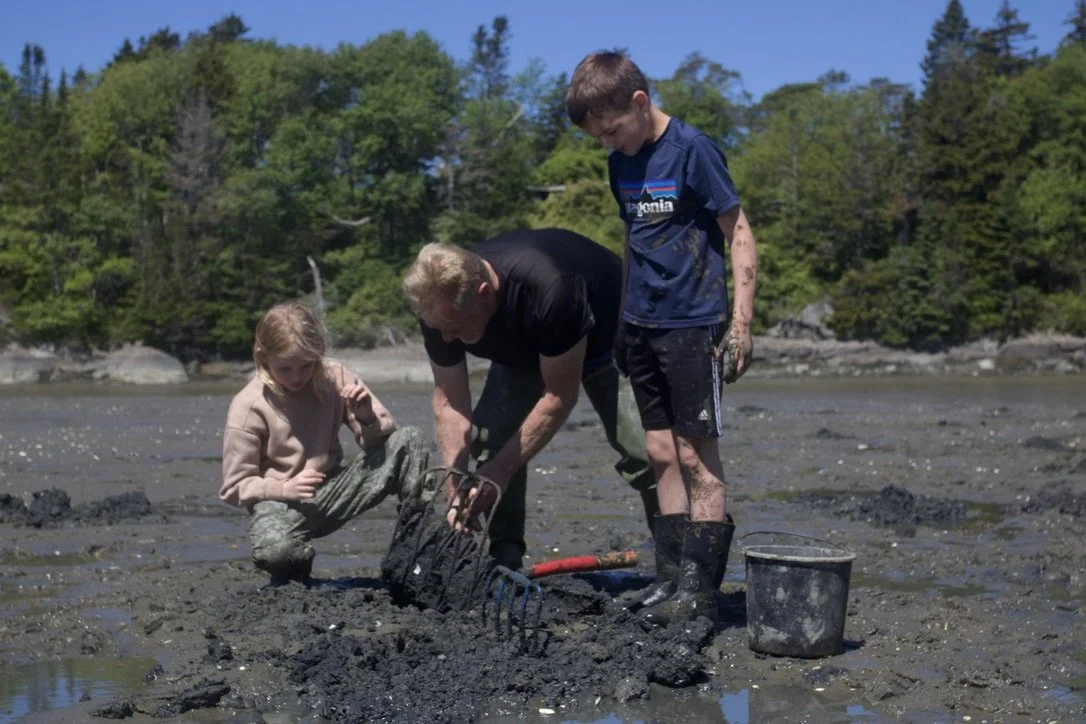
The kids and Terry exploring the mud.
THAT WE ARE living within an environmental crisis is evident. Depending on your vantage, it is slow or fast, its worst peaks already arrived or only distantly impending. In such a crisis, environmental communication must reconfigure.
I think about this quite a bit, how we are still all living in the reverberations of sudden globalization, and how our systems of communication and environmental understanding are still playing catch up. We know that environmental crises deepen social inequities. As climatic polarities cause floods and droughts, social polarities deepen. And as that upper wealth gets more massive and able to consume more, the climate suffers, compounding the problems.
As things get scarier, we tend to lump ourselves more tightly into our in-groups. And as resources get more expensive, those at the top tend to benefit from the losses of those at the bottom. The history of the local housing market is an obvious example of this. As fisheries lose value, long-time marine harvesters move inland, opening up family homes for sale, and taking their embodied knowledge with them.
These growing inequities, cyclically compounded by a growing social discord, too often devalues the voices and knowledge from those who are most impacted by and therefore most knowledgeable about the evidence of ecological calamity.
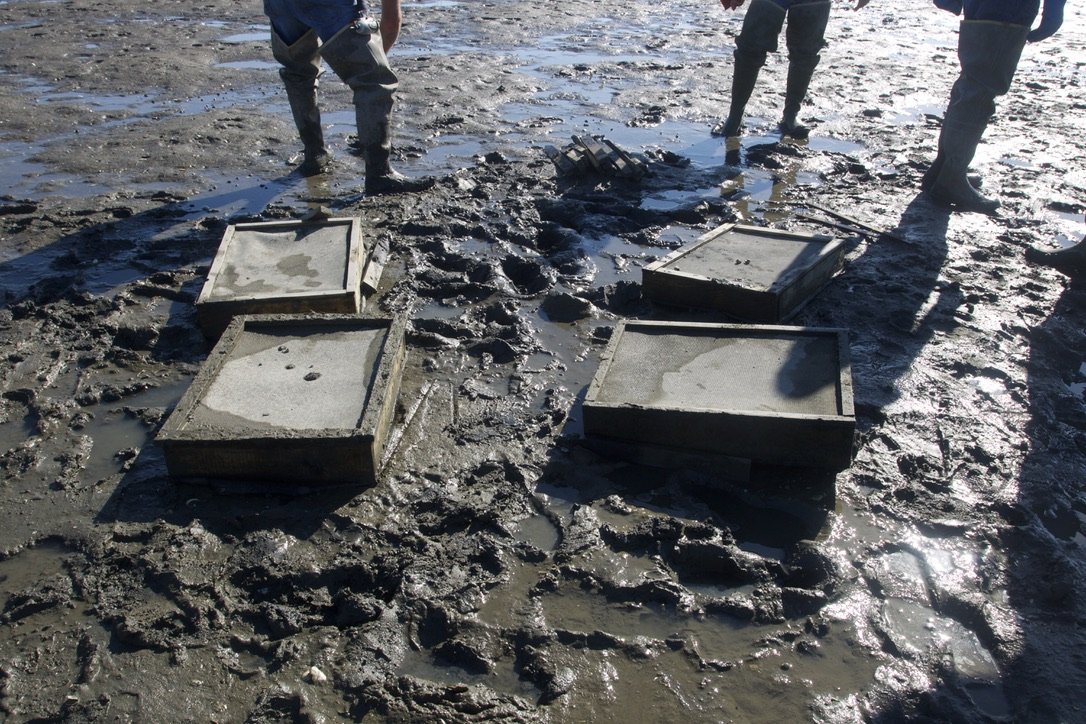
Seeding boxes are laid in the spring to catch and measure wild shellfish seed.
WHEN YOU LOOK very closely at a mudflat – when you step right in with your hoe and bucket and sled in which you will haul your harvest home, when you bend down and feel the animals and plants and minerals and weighty, delicate flux of it all passing through your fingers – you see that a mudflat is alive all over and through itself.
It has many, many qualities that statisticians don’t yet measure. But I’d bet that the people out in the mudflats every day are always taking note of physical changes. This is the beauty of the embodied knowledge required for any harvest – it’s a vast education of constant observation.
No matter where we work, our bodies see as they feel, storing the information all through ourselves – kind of like a mudflat, full of diverse awareness. The future of environmental communication will likely find ways to bend the language of algorithms to better speak with this more human – and more complete – narrative. Maybe this is wishful thinking. But the more I talk about the need for interdisciplinary work and study and regulations, the more I’m finding that there are already so many scholars, resources managers, harvesters, and policy makers saying this very thing.
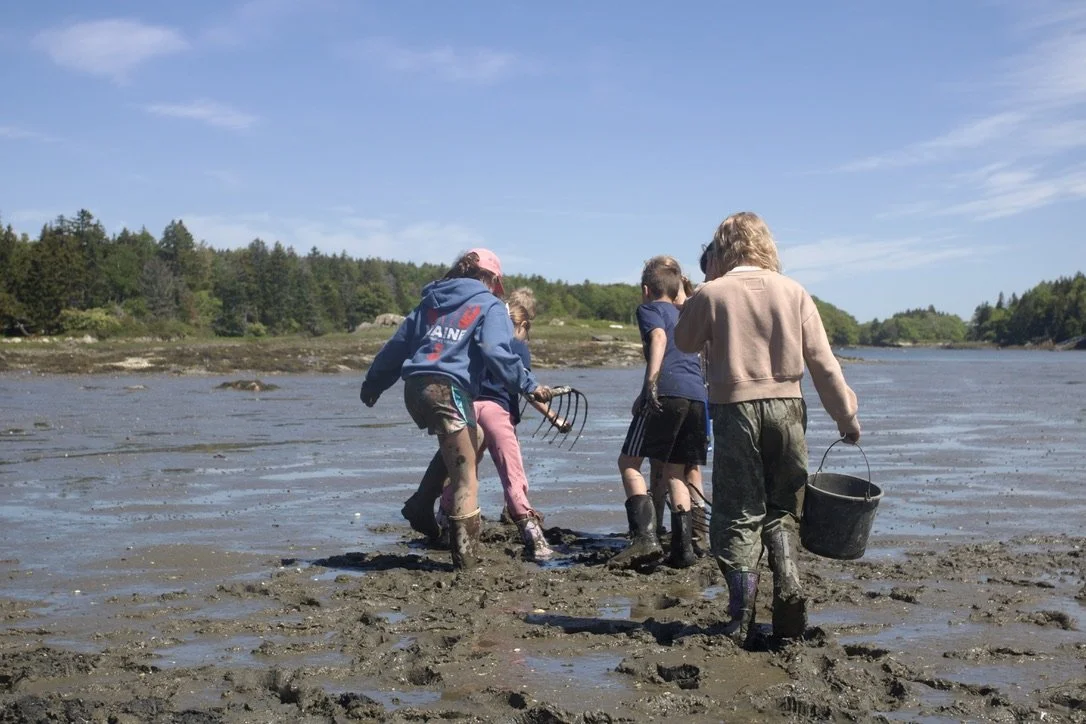
Guided by Phippsburg clammers and Kennebec Estuary Land Trust collaborators, Phippsburg elementary school kids learn and play in the mudflats. This annual field trip was held on a bright early June day. I’ve included some photos in this essay. Kids know how to look, wonder and see.
In the next two blogs, I’ll talk lawn care, pesticide run-off, and a bit more about the limitations of ecological management in the context of Phippsburg’s intertidal systems. That might be in a few weeks – I’m out of town until late June. Until then, enjoy this strange and pretty spring.