A Lack of Access
EVERY FISHERY, ON every coast, has their own specific vocabulary. Most words are like deep water – on calm days you can’t tell by the surface just how strong the currents run. Words associated with fisheries are no different. When I first got to Phippsburg, I was curious about the subtleties of local semantics. I asked clam digger and oyster grower Terry Watson: Is it “clam digger” or “harvester?” I was writing a piece for Island Institute on his intertidal stewardship and life of wild harvest advocacy. I had a sense that though these terms are sometimes used interchangeably, the variances in their underlying connotations might be significant. His answer, like those of most people who I’ve posed that question to since, helps illuminate the meaning beyond–and within–the words.
If you know Terry, you know he’s a joker. Last fall, I went to a sold-out comedy show that his son Casey was headlining. On stage, Casey described how their family deals with problems through jokes.
“To be a good digger you need a strong back and a weak mind,” Terry said, when I asked him about the semantic difference. To be a shellfish harvester, on the other hand, you need to want to look good for the yuppies. Obviously, Terry was joking. Nobody who makes a living out on the flats has a weak mind. Mental perseverance and attention to minute detail is crucial for digging. In that joking answer, however, I heard how he perceived and digested the stigma that gets laid on clam diggers.
“Clam diggers,” he continued, “have the reputation of being the guys that can’t hold a job, do drugs and don’t care about much of anything. Some of the guys I have bought clams from were teachers, marine draftsmen, a surgeon, mechanics, carpenters, college students, you name it,”
“There are plenty of low lifes. But they are everywhere. I raised three boys, they all went to college and all make the world a better place. People still look down at clam diggers.”
I hear about this stigma often. Many clam diggers and folks close to them, here in Phippsburg and beyond, have described bits of its impact to me.
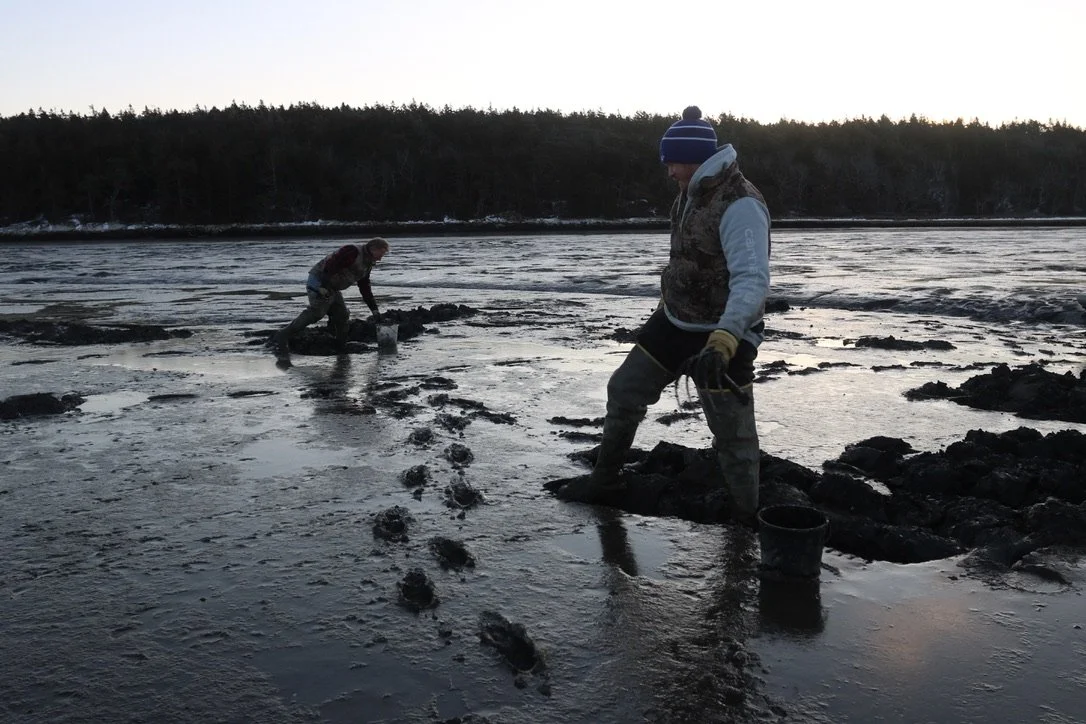
Generations: Casey Watson, Terry’s son, supports his comedy career with the independent income he digs out on the flats. All emerging artists, besides those with trust funds, need side hustles.
MARISSA MCMAHAN OF Georgetown – long-time commercial lobster license holder and the Director of Fisheries at Manomet Conservation Sciences – confirmed the reality of this stigma. It was, like most stigmas, misguided. “[Manomet] worked with younger diggers,” she said, “who paid for their college education by digging clams in the summer. I know many people who have been digging clams full time for decades, but also have a college degree or have worked in other industries, but prefer digging clams to anything else.”
Unfortunately, stigma has real consequences. How a community understands each other shapes how resources, support and general dignity are allocated. For instance, look at how much attention policymakers in Augusta and elsewhere are giving to oyster farming, touting its long-term reliability over wild harvest. Consider where research dollars are spent. Or how philanthropic dollars are allocated.
Supporting fisheries diversity means supporting biodiversity and economic diversity–both key to long-term ecological and social stability. As much as we’d like one silver bullet of a solution to big changes, likely we’ll need a whole mix of solutions–new and old.
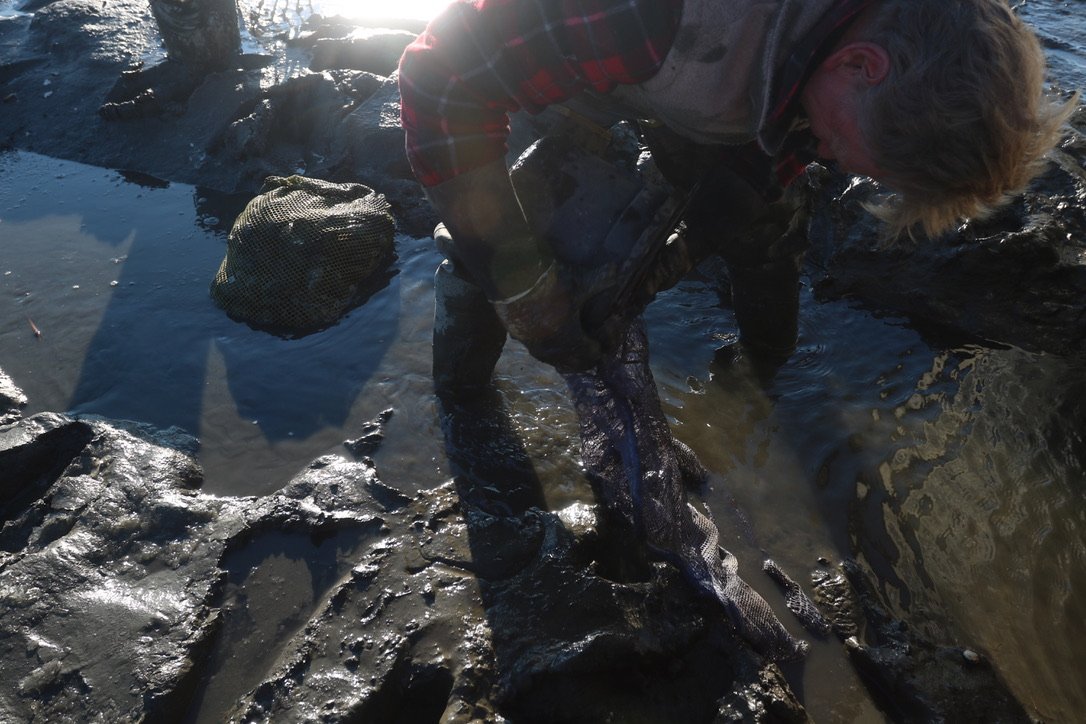
A clean harvest: When I think of the unfathomable waste big, off-shore trawlers produce, and compare it to the delicate, precise way that diggers harvest clams by hand, the difference — if it wasn’t so tragic – would be laughable. You want artisanal? Eat a clam.
SURE, THERE’S FRUSTRATION with tricky communication and concern rising with changing ecosystems and property lines, but listening to the diggers talk about their work, I don’t hear much yearning for a different life. Maybe I’m getting the glossed-up version, or just listening selectively. But again and again, while out on the mud with them, or in meetings, or just chatting on the phone, I hear the refrain: “I’ve tried all sorts of other fisheries. I always come back to digging.”
I wonder if the independence of digging is not unlike that of writing. Very few tools are necessary, besides one’s own capacity for dedication to the work. And let me tell you, after getting out and trying my hand at flipping the mud, the dedication to the work that is digging is unfathomable. Just like any fishery, clam digging has to be a way of not only making a living, but a way of life.
After Terry described the nuanced difference between shellfish harvester and clam digger, he concluded, “I’m a clam digger.” Though he laughed, I heard an undercurrent of resilient pride–the sort that belongs to many folks who have been categorically sidelined.
I SHOWED UP to Phippsburg not knowing much about mudflats. Beyond a culinary appreciation for shellfish, I hadn’t given them much thought. This is unlike me. Usually, and especially when it comes to seafood, I want to know all about supply chains. How far have these mussels travelled before they landed in this brothy bowl? What savvy hands harvested, processed, packaged and shipped this cod cheek? What was the rex sole’s life like, forty fathoms down? And is the dollar amount I’m paying for this meal equal to the toll its removal had on its ecosystem or the labor it takes to turn a wild thing into an edible morsel?
All this to say, until a few months ago, I didn’t know diddly about Maine’s wild shellfish harvest. What happens out there on the mudlats? Do the clam diggers receive government subsidies like big off-shore trawlers do? (Ha.) How do diggers fit in their working waterfront communities? What’s their status?
Maine’s wild shellfish harvest is the state’s second most valuable fishery, raking in over $15 million in 2024. “Maine’s softshell clam fishery continues to be one of the most lucrative,” said DMR Commissioner Patrick Keliher. Yet, in the public eye, it remains sidelined into relative obscurity by the more familiar images of lobster boats (and, admittedly, their $500+ million fishery), or the nice SEO-positive videos and Instagram pages that new oyster farms use. Of course, resources are limited across the board, and every marine harvester working on Maine’s coast, no matter their harvest, is just trying to make a solid, sustainable go of it.
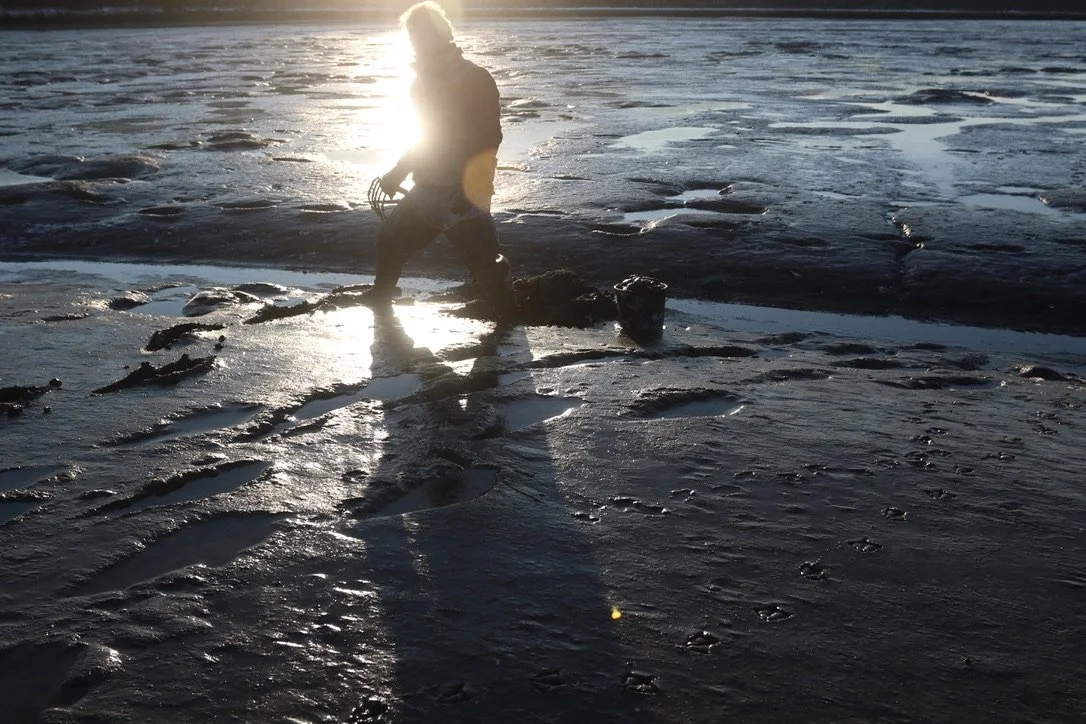
“Flipping” the mud, I’ve learned, is not so simple as it sounds. It’s a quiet, meditative hunt, one that is attuned to every small change in the mud. (Note the gull tracks in the foreground—mudflats are crucial harvesting grounds for many.)
MUD FLATS ARE WORKING WATERFRONT, TOO
IF YOU’VE TALKED with me at all in the few months I’ve been here, you know that one of the big problems consistently on my mind is the loss of clammer’s historical access points to the mudflats. This problem is wrapped up in the very social stratification that Terry described. A lack of social currency, based often on cultural misconceptions, shapes how we prioritize our marine management resources, research and protection of working waterfronts.
Even well-meaning folks who I like quite a bit deride the clam diggers–to my face. I don’t think they realize they’re doing it, so deeply entrenched is the cultural disregard of clamming. Somehow, though my job description explicitly states that I support restoring historical access routes for clammers, some people (but not all, by any means!) seem to assume that I share the view that clamming is a) doomed b) economically insignificant and c) the domain of those who can’t afford or otherwise make it in a “better” fishery, one that requires a vessel and wharf access, let’s say. Again, I’ve been out on the mud, have felt digging’s quiet, calm and necessary work ethic, and now listened to multiple diggers describe how they’ve tried out other fisheries. “But I always went back to digging,” Terry said.
Some folks in town play down the significance of mudflat access, citing how few clammers there actually are. A few months ago, I was talking about the uneven distribution of resources with Bridie McGreavy, Associate Professor in the Department of Communication and Journalism at UMaine, and fisheries advocate. She framed that paradox like this: “People assume clamming is doomed.” So they doom it further by eliminating it from conversations.
In a town the size of Phippsburg, the twenty-odd wild shellfish harvesters, and the families they help support, make up a significant part of our community.
TRENDING IN THE ATLANTIC NORTHEAST
RECENTLY, I WAS at an evening event at the Gulf of Maine Research Institute, at which GMRI President Glen Pricket, Chief Community Officer Jonathan Labaree and the Executive Director of Lowell’s Boat Shop, Graham McKay, described how waves of coastal gentrification can decimate the functionality of working waterfront.
Labaree described the familiar trends on the Maine coast: crowding out of commercial moorings and wharf access by recreational boaters and shore-side residents. Then, McKay showed maps from the 1800s, in which the surrounding Amesbury, MA waterfront was full of diverse family-owned businesses. In 2026, Lowell’s is the last commercial property in the area.
Here’s another example of working waterfront loss they might have offered:
Somebody looking for the coastal quiet of Maine moves to Phippsburg, maybe for a well-earned retirement or vacation from the draining urban buzz. (I just went outside in the snowy moonlight and all I heard was an owl. Which is to say, I get it – the Midcoast is sublime! I’d want to settle in here too.) They buy a piece of waterfront land. The sunrises are stupendous, that eastern bay a bowl of fuschia some days, foamy steel another. The land itself feels wild, craggy and spruce-snarled, a little dangerous–just enough–and with different, more interesting tensions than are found in the familiar exactitude of city blocks and office stairs. Life slows down here, gaining a sense of welcome privacy. But then, at some draining tide, high noon just slipping over to longer shadows, this newcomer sees a stranger passing over the edge of their property.
The stranger seems overly familiar with the land. He’s making his way on a small trail through the spruce, down to the glistening mud. Perhaps the stranger wears a worn-out sweatshirt and tall boots, drags a sled full of bags, gloves and sharp hoes. Maybe he’s surprisingly reticent–even calm–when the homeowner confronts him about this unexpected incursion. Maybe the quiet, thoughtful nature of some diggers is unsettling for those coming from the city, used to a culture of louder chatter and quick comebacks.
Or maybe, the digger, frustrated with a continued loss of crucial workspace, alarmed by the hours of digging–and thus income–he will lose if he has to take the long way around this property, isn’t all that calm. I also understand this.
Either way, the newcomer, having never heard of such a thing as “hand-shake” agreements or the “law of prescriptive easements,” nor having given much thought to Maine clam diggers, is aghast at this intrusion onto their property.
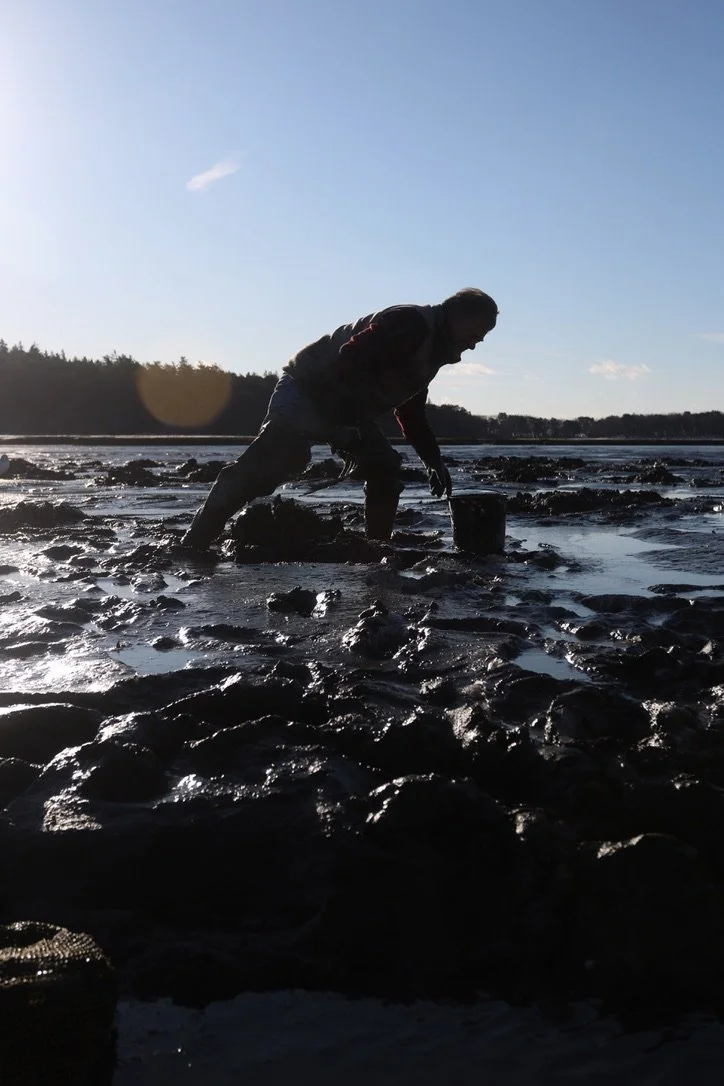
Terry and other diggers, like Troy McNeil, are slowly teaching me how to walk less like a frightened buffoon on the mud.
DAN DEVEREAUX IS the former Shellfish Warden and current Coastal Resource Manager of Brunswick, and cofounder of Mere Point Oysters. I asked him about difficulties the waterfront is facing right now. “Gentrification is the biggest problem for working waterfronts.”
It’s not always newcomers who deny access. Nor are restrictions always without cause. Some access points are restricted after somebody–clam digger or otherwise–misuses it, or for some other valid reason. Lobsterman Ethan Debery, whose family has long allowed clammers passage to Atkins Bay, described how the use and maintenance of private roads can sometimes be a tricky hurdle in mudflat access. Unfortunately, all of this is compounded by a culture that says it’s alright to offer some people less dignity and a right to their traditional work than others.
Loss of shore access isn’t just a Phippsburg problem. Nor is it simply a mudflat problem. Nor is it even solely a fisheries problem. Maine State Senator Denise Tepler (D-Sagadahoc) told me that she finds the loss of recreational shore access, let alone access to working water in the last decades, “unbelievable.”
The desire to move to this beautiful place is relatable. I’ve chased coastlines for the last decade. And it’s understandable that arriving to a community that thinks about land use differently might be a tricky transition. But I think part of Maine’s charm is rooted in that difference, a sense that we can wander here a bit more than other places.
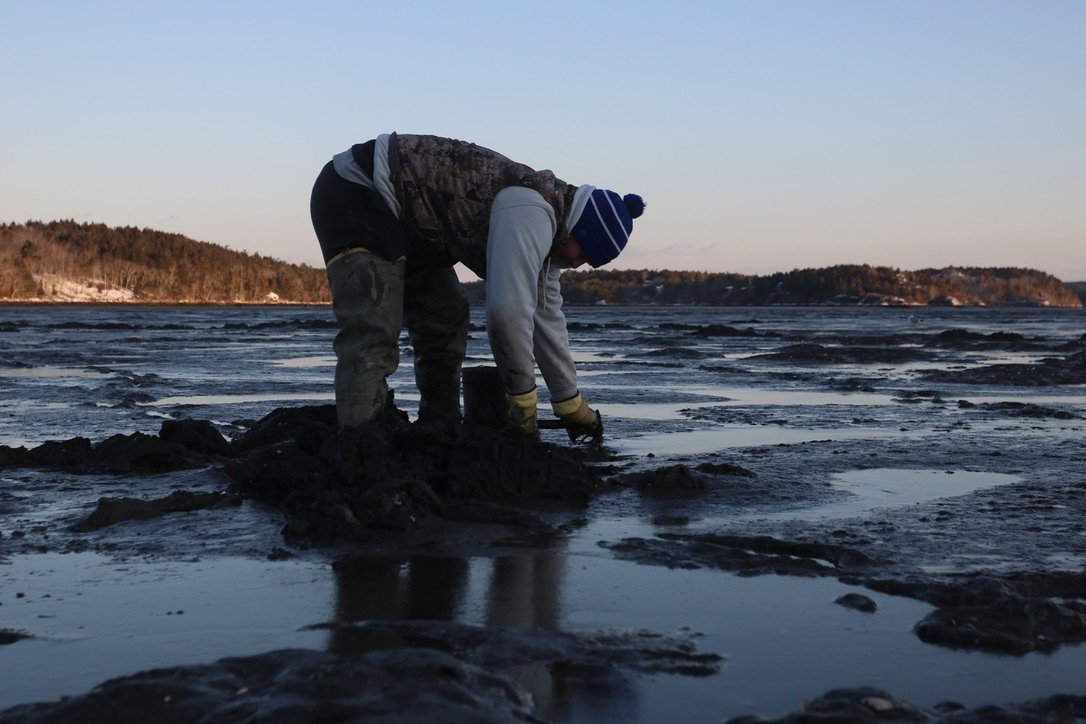
If you haven’t been out on the mud, come try your hand. Recreational Licenses can be found at the town hall and there are plenty of diggers in town to teach you.
HOW DOES THE clam digger see the property owner, in such a hypothetical situation as I outlined above?
“They’re just ignorant and it’s not their fault. But it messes things up,” a young digger told me recently. When I bring up shore access with diggers, I sense a resigned frustration – one that often makes way to jokes.
At a recent Phippsburg Shellfish Committee meeting, one clam digger reflected on attempts to talk with landowners. “We can talk with them until we’re blue in the face. But they come out here with an argumentative attitude. They don’t want to talk. We need a landowner who gets it, to talk to the ones who don’t.”
At that meeting, there were clam diggers ranging in age from young twenties to those who have been digging upwards of a half-century. People told stories about boyhoods on Phippsburg’s waterways, remembered and retold for decades. They made jokes about who was getting old enough to be booted onto a seniors’ license and discussed shellfish seeding projects for the spring.
Everybody had a story about changes in mudflats, property lines and regulation. The continued loss of places to launch and moor boats came up. Some flats are much more easily accessible by passage over water, in canoes, airboats or other small crafts. Losses of boat-launch parking exacerbates this. “Kinda like offering jobs and taking applications but knowing there is no parking for the employees,” Terry phrased it.
Clam diggers are not the only ones worried about shore access. Last winter, Robin Wallace of Sebasco interviewed more than forty Phippsburg lobstermen and diggers. When she asked if they felt that the use of and access to the water for commercial use was declining, nearly all voiced concern. “Noncommercial people can get to the water, more and more fishermen can’t,” went the refrain.
The increase in old family homes transformed into AirBnB rentals and summer places exacerbates the problem. If somebody visits or moves to Phippsburg, believing they’re just coming to a pretty patch of coastline, and doesn’t stick around long enough to learn about the actual functioning of the town, then sure, they might be reasonably alarmed by a stranger crossing their yard at dawn. But there’s thousands of years of fishing and digging history that exist below–and form–Phippsburg’s pretty surface.
Like I said, before I came to Phippsburg, I wouldn’t have been able to tell you a thing about the commercial harvest of wild shellfish. I think that spot of ignorance was in part the result of a general lack of public attention to the fishery, in which I was participating. Though these big social patterns aren’t any one person’s fault, they are perpetuated by and impact real individuals. I’m quite glad that my fellowship offers the opportunity to work closely with Phippsburg’s clam diggers. It’s opened up a whole new tree of things to wonder about.
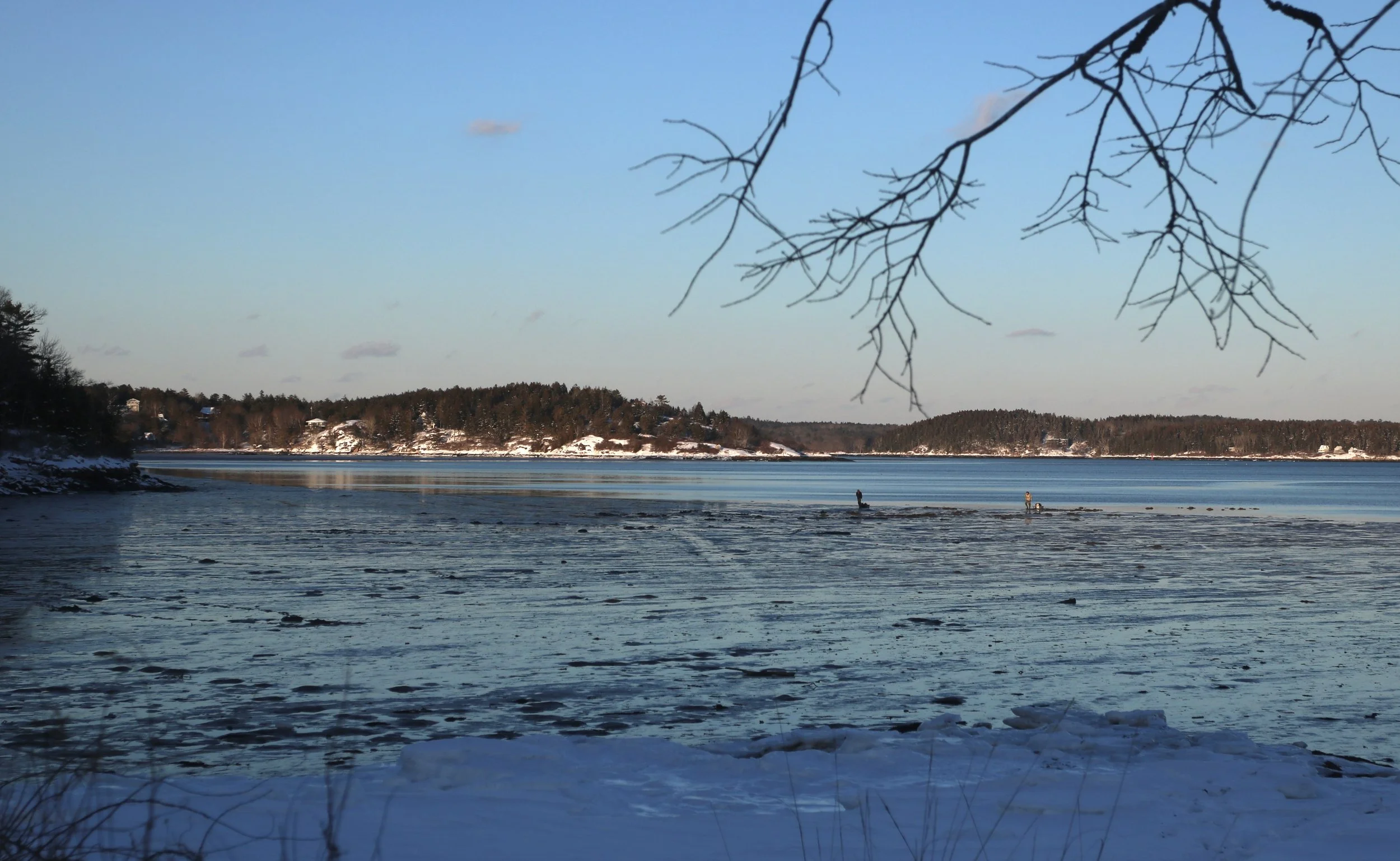
Troy McNeil and Phippsburg Shellfish Commission Chair David Gray make their way back to solid shore.
WAYS FORWARD
AT THAT RECENT GMRI event, after listening to the panel discussing gentrification’s impact on the working waterfront, but hearing no mention of mudflats, I asked Jonathan Labaree about trends in the loss of intertidal shore access. Did he think the continued loss would be linear? Or did he imagine a shift in trajectory? His answer was thorough, encouraging and educational for those in the room who hadn’t yet started to think about where their steamers come from.
As he talked, I saw several people in the audience nodding, confirming that others understood the need for shore access. After explaining in detail the significance of mudflat access points and their growing protection through private easements and public land trusts, Jonathan said he was hopeful the loss would slow. “Coastal land trusts are increasingly aware of the loss of mudflat access,” he said, “and are partnering with clammers, landowners, and towns to protect traditional trails and restore access.” And with increased education about the traditions and places of work they’re moving into, it’s possible that more newcomers will understand the true impact that denying access to clammers can have on a community.
Plenty of people, of course, understand the significance of clamming, respect the diggers, and allow access without a second thought. It’s all about education. Sometimes when people realize how their property connects marine harvesters to the waterfront–and their livelihoods–they act to protect that connection.
Since I got here, I’ve been working with Terry Watson, David Gray and members of local land trusts to identify shore access points that we might help solidify through language. Towns up and down the coast are offering new ways for landowners and diggers to develop shore access agreements. Terry and David understand shore access across private property is tricky sometimes. They want to collaborate with landowners. They’d rather know best-use practices before land owners feel like their property has become a free-for-all.
Lobsterman Ethan DeBery and his family have allowed clammers to cross their property to Atkins Bay for a long time. “It just seems so obvious. People want food. People want to make a living,” Ethan said. He understands that no one really wants their yard to be a public space. It might be tough to come to an agreement about the specifics of land use. “But they’re not trying to be in the yard, they’re just trying to get through it,” he added.
Other folks in town are working with Maine Coast Heritage Trust to parcel out parts of their land for mudflat access. This sort of easy collaboration is what makes a fishing community function. It’s exciting to witness this eager growth of collaboration.
Though bouts of heady idealism come and go all the time, I’m more useful when they’ve struck. In these weird times, deeper collaboration of all stripes feels crucial. I think some collaboration will take forms we don’t yet recognize as collaboration, like, say, expanded ideas of who belongs in one’s community and who does not, and who, within that community, has the right to access the intertidal.
If you’re curious about this work, would like to know more about how you can help define access points on your own land, want to vent or provide a fact check, please do get in touch: kcart@islandinstitute.org.
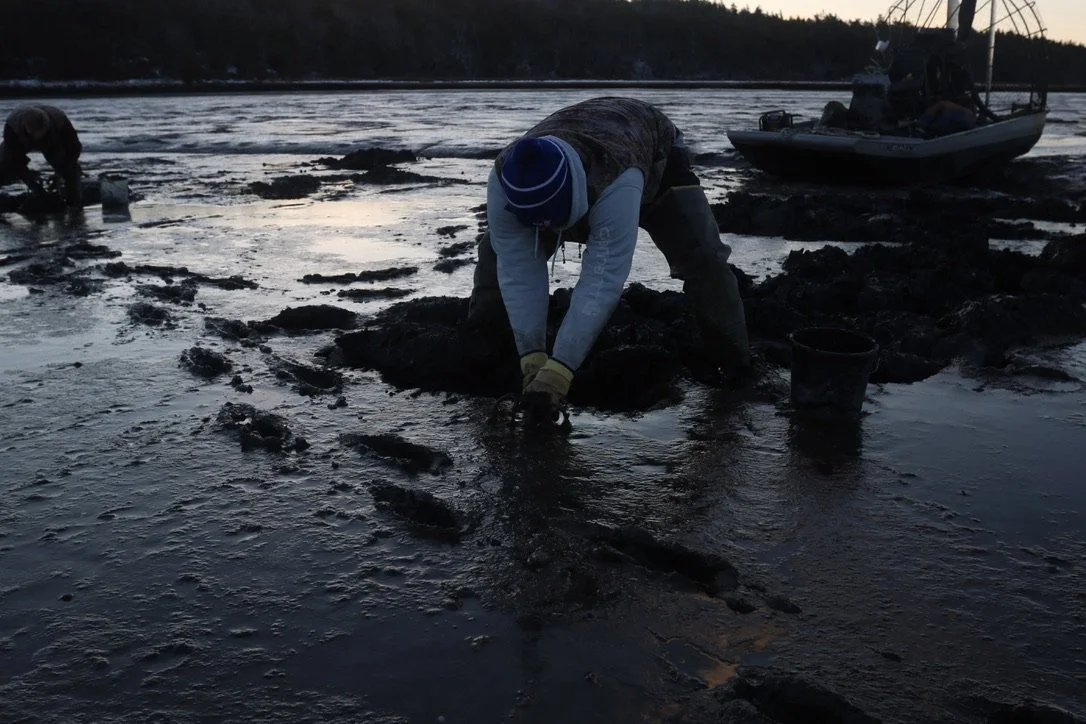
When shore access is lost, small crafts like Terry’s airboat can help diggers make up the lost time. If you hear that brief motor passing, you can bet sure as clockwork that the tide is draining or flooding back in.
Oral History Event: Terry Watson to talk at Small Point Baptist Church. 2pm February 14.
Coastal Access Strategy:
https://www.mainecoastfishermen.org/case
Landowner Liability:
https://www.maine.gov/IFW/hunting-trapping/accessing-private-land/landowner-liability.html
Accessing the Maine Coast:
Harpswell land-owner, harvester collaboration, and solid interior design:
https://www.decormaine.com/homes/a-working-waterfront-transformed/