Locus of the Harvest
AFTER WE TIED up at the boatyard, Dan Watson told me, “I expected you to bail.” We’d just returned to the icy dock, back from an early morning of raking for quahogs around Phippsburg’s western inlets of Phippsburg. It was cold in a way that made me feel like I was really working. Winter came fast this December and Phippsburg’s shorelines were white.
I had left my house at 5 a.m. that day. It was one of those cuttingly clear skies. Stiff moon, bright stars. As I drove across the peninsula to Sebasco, my car read 4º Fahrenheit. By the time I was parked nose to nose with Dan’s truck, it had crept up to 5º. I hadn’t officially met Dan yet, but had been introduced over text through his uncle, Terry Watson. And I’d heard him talk about problems with local moorings at the last Shellfish Commission meeting. That morning, Dan emerged out of the dark boat house, turning his head lamp sideways so as not to blind me. He didn’t know if we’d make it out, he said. The outboard had a kinked fuel filter. Because I’d had a whole mocha pot of espresso and knew I wouldn’t get back to sleep, I said I might as well poke around anyway, take a few underexposed photos. I hadn’t been down this way yet and the wintry glow of the boatyard’s lights in the dark had its own industrial sort of beauty.
Eventually after a few false starts, Dan got the outboard running. An hour later the sun came up. It was a bit of a steam to where we were headed. Slush floated near shore. We chatted about various things, told stories of past fishing jobs we’d both had. North America’s fishing community sometimes feels really small. Turns out we’d likely both known someone from an Alaskan crabbing crew, a guy I’d been stuck in the Anchorage airport with, who had come to Maine to fish. Inevitably, however, wherever our talk meandered, it returned again and again to Phippsburg, its people and variable spaces. That day got me thinking about food, food systems and the large cultural cycles that are linked so closely to our food – and thus to our ecosystems. This blog post might get a little academic down the line, but bear with me. Dan made for a great guide of Phippsburg’s local foodwebs and how the perception of harvesting that food is changing in the minds of those on the shore.
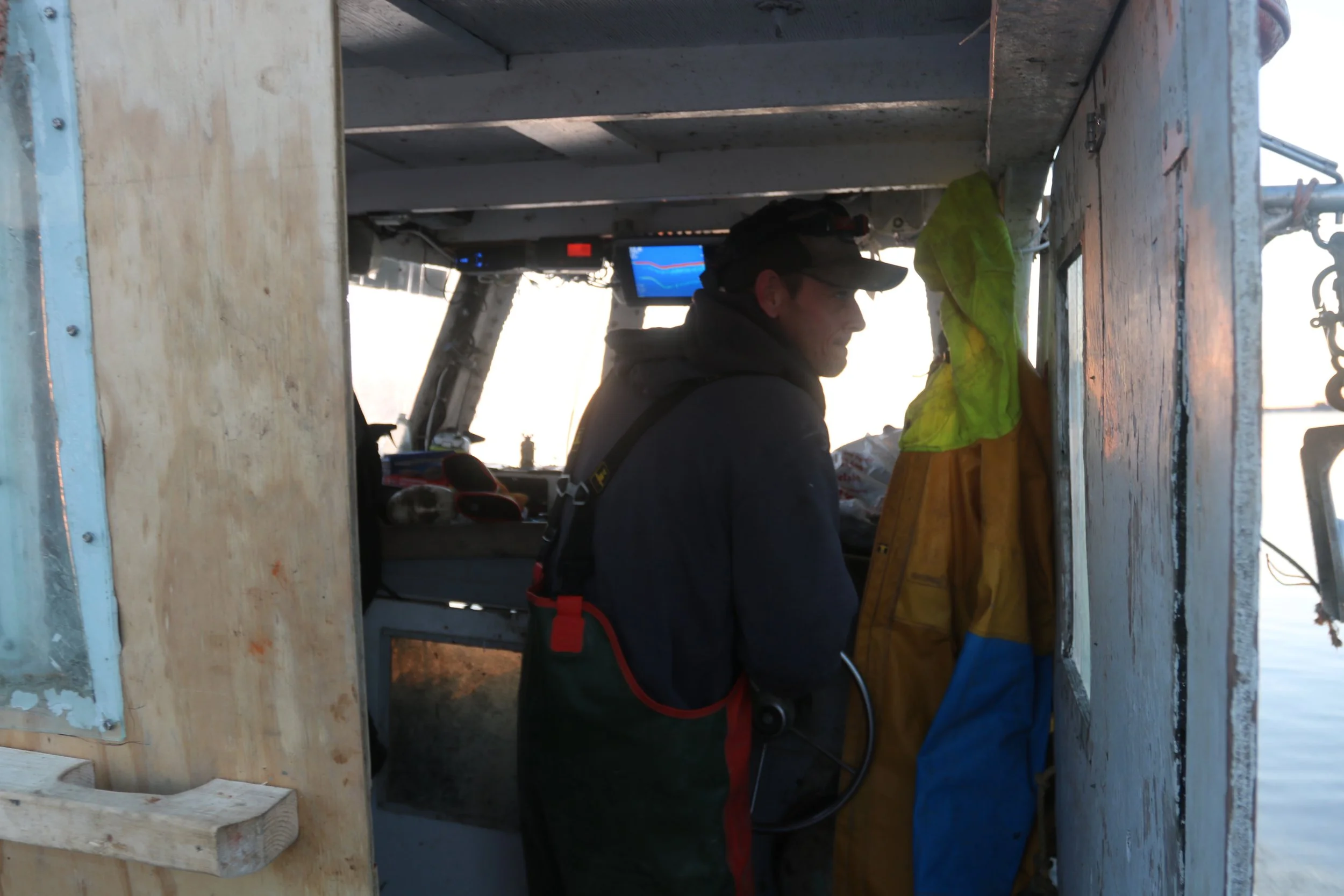
HAVE YOU EVER seen Phippsburg from above? Or looked at a geological map of the peninsula? This place is odd, diverse in its physical composition. During the last ice age, the Laurentide Icesheet compressed the northern summits of the Appalachian Range, gouging, shaping, flattening, leaving these long fingers of land that extend into the Gulf of Maine. Today, oceanic currents and weather spin in their global patterns, and push all sorts of tides onto our shores. Wavebreak and river currents shape the coast one way on Phippsburg’s eastern hem and another in the western inlets. There are deep coves, wide flats, strong eddies, and quiet marshes. The range of working waterfronts and fisheries knowledge echo this land’s diversity, in turn influencing the shapes of communities.
Dan pointed out geologic peculiarities. Indicating benthic ravines and high scarps, he showed me what was hidden behind sea smoke, the outlines of pine covered ledges and islands illuminated by the rising sun. The plotter showed a deep underwater channel between two pieces of low- lying land. Dan said, “This is where the ice probably scraped down, between these hills.” I asked if he meant glacial ice. Yep, he said, or that’s what he assumed anyway, knowing the icy history of this old coast. He described how fish and lobster, just like humans, search out the easiest route. “They won’t climb over that ridge,” he said, indicating topo lines describing the edge of this underwater canyon. Lobsters run thick in areas like that.
I love quiet information like this. Fishermen who return again and again to the same waters and shores know them in ways I never will. I myself like speculating on the patterns that exist below both material and social surfaces. Every time I’m out on a boat with someone, I know that even though we’re on the same vessel, on the same water, looking and smelling and hearing the same stuff, we’re having two entirely separate experiences. That’s what knowledge does: It informs the senses.
I’ve worked as a field biologist, studied marine science, and written about fisheries for a while. But compared to a fisherman or woman who has worked and cared for the same undulating seascapes for their entire life, I know frustratingly little. Or rather, I know some big-picture stuff, whatever I could glean from books, news, archives, land-locked rumination and my own relatively short experiences on the water. But I don’t know any water or really anywhere as intimately as a fisherman knows the mud, the seasons, the shapes of currents, the nooks of rocks, the histories – ecological, social, geologic, you name it.
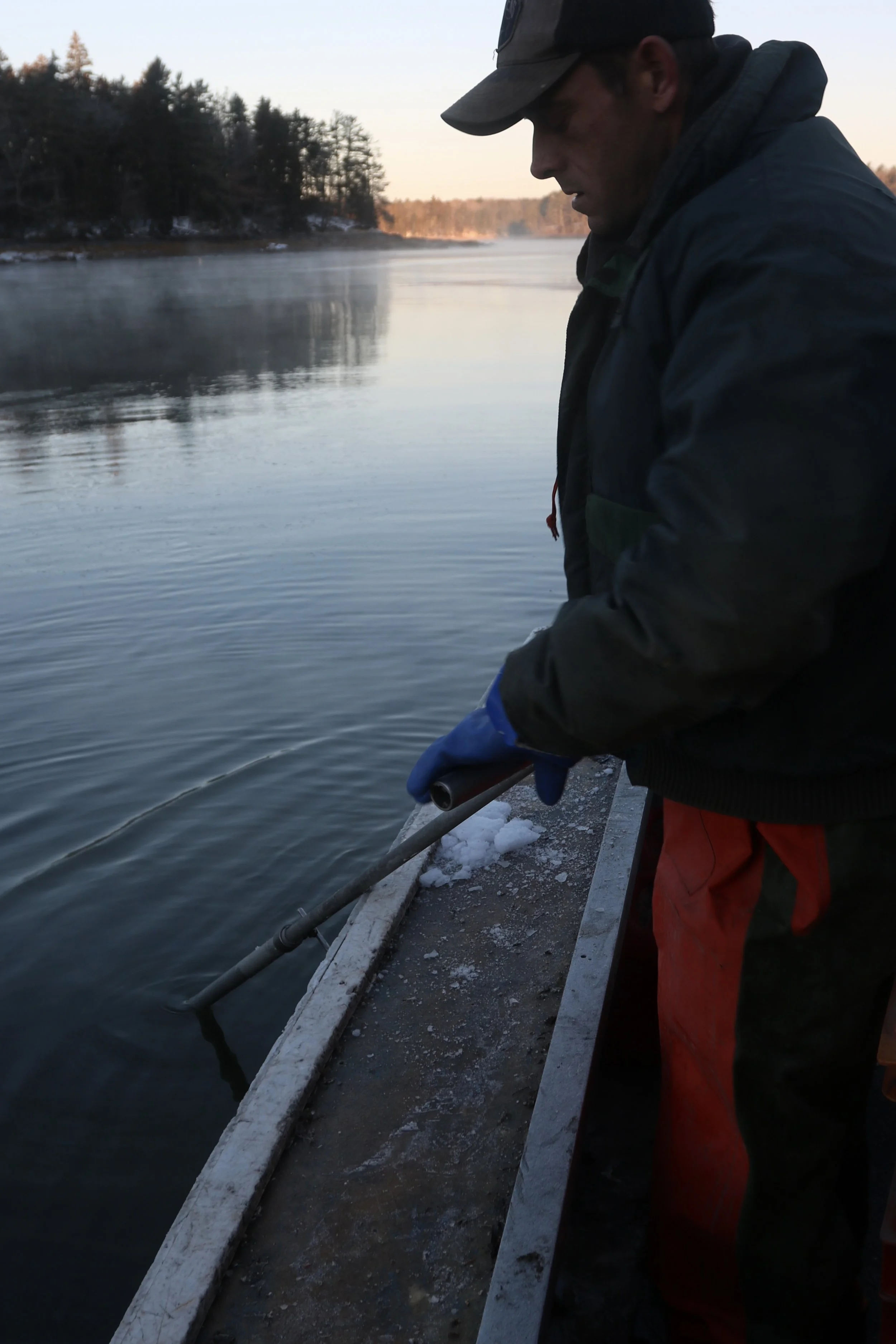
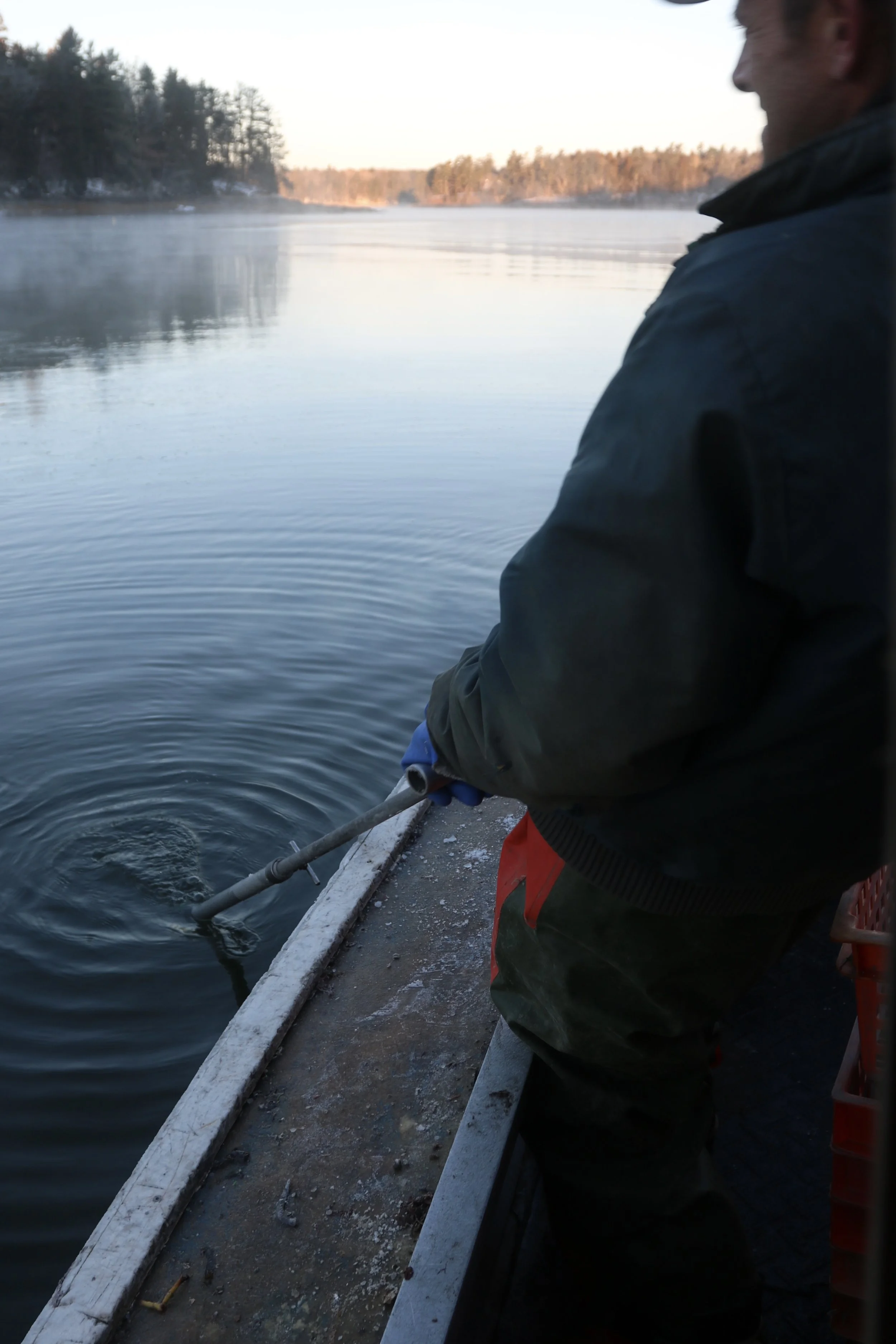
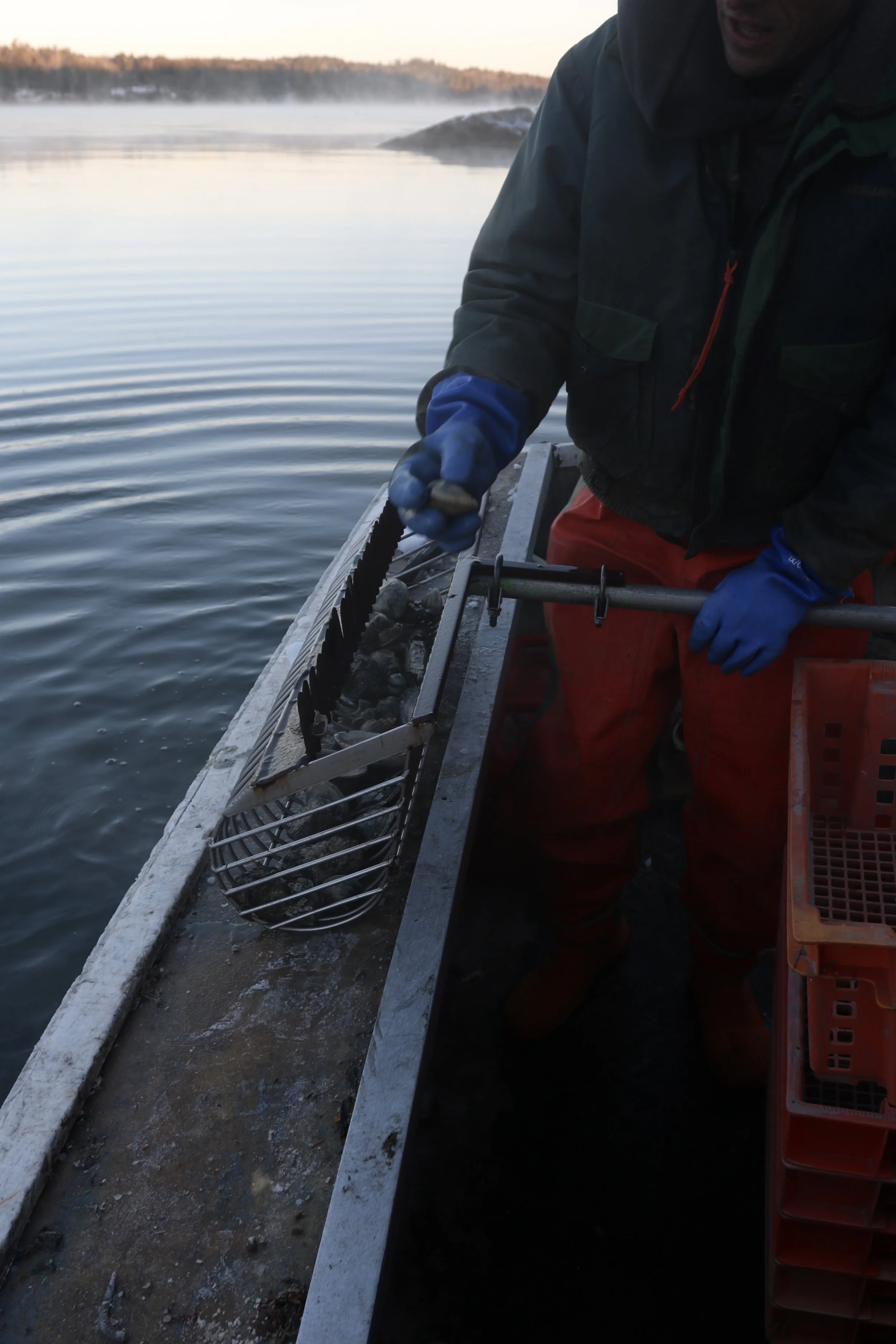
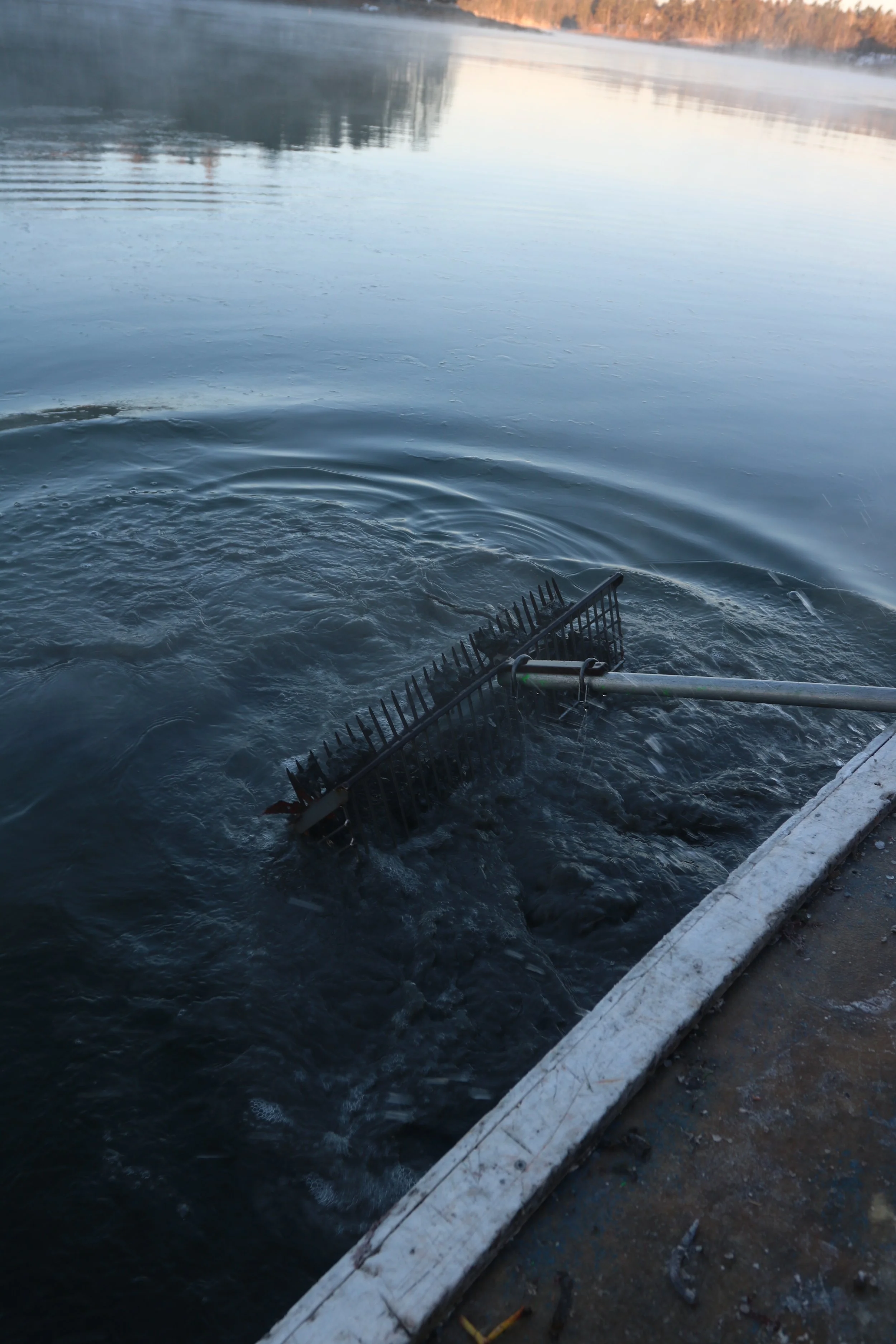
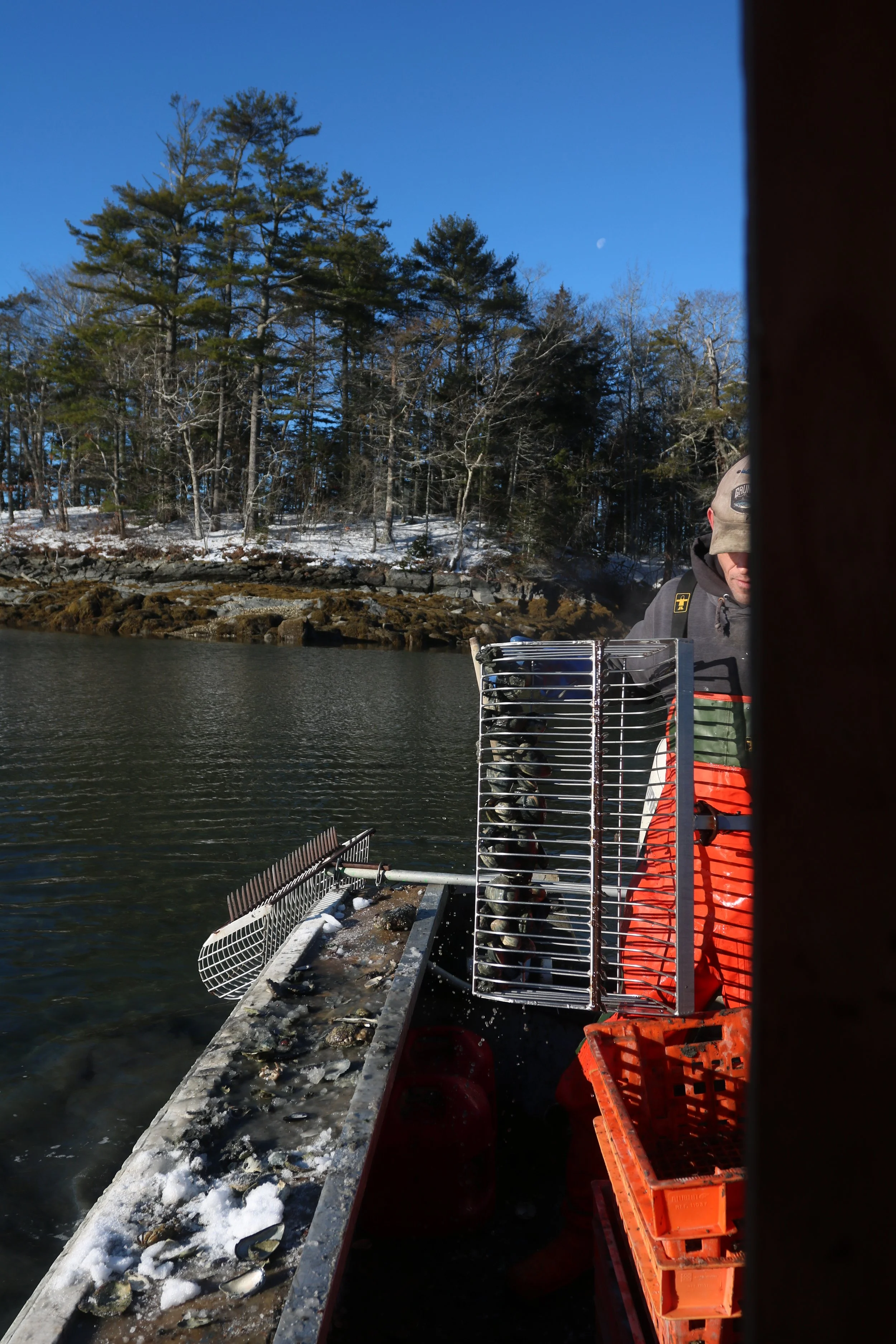
DAN SHOWED ME, sort of, how to rake for quahogs. The rake has a long pole, some ten or fifteen feet, with a basket and rake attached at one end and a straight handle to haul back on at the other. There’s a seemingly infinite amount of rake types, he told me. Nuances in construction to fit to a body’s preference, to mud, to season, to species targeted. “The mud gets stiff when it's cold like this,” he said.
I say “sort of,” because raking, like all marine harvesting, takes a body-knowledge I couldn’t learn in a morning. Though I got an idea of what I might need to learn, if I ever wanted to make a go of it. Let the rake settle on the bottom. Dig the tines in a bit to the mud’s surface. Peel a lip of mud up and flip it over, before yanking the rake in little jerks toward yourself, feeling the shells, pebbles and whatever little sticks rest on the benthic surface rattle through the metal of the basket and handle, up to your hands – a sort of communication between earth and person, through tools.
Just like an echosounder reads the bottom through sound wave pulses and displays it in a pixelated, visual narrative, the physical reverberations of the rake tell a story to the palms about what’s happening below the water’s surface. All the while the boat, a twenty-two-foot dory with an outboard, is drifting on the mechanical anchor that is your body and the tines in the mud.
Dan hauled the rake up, spun it round as he pulled, so whatever had been collected in the basket didn’t spill, and then rinsed it. Like any sort of harvest, it’s a physically taxing set of movements, compounded that day by the cold. But there’s nothing really better, Dan said, than fishing, than being on the water, pushing oneself outside. Later, I asked him about young people around here, people our age, in their thirties, if there were many who fished. He didn’t really answer, maybe because he knew that I knew what the answer was anyway. It’s clear that most fisheries are located in aging communities. Phippsburg is no exception.
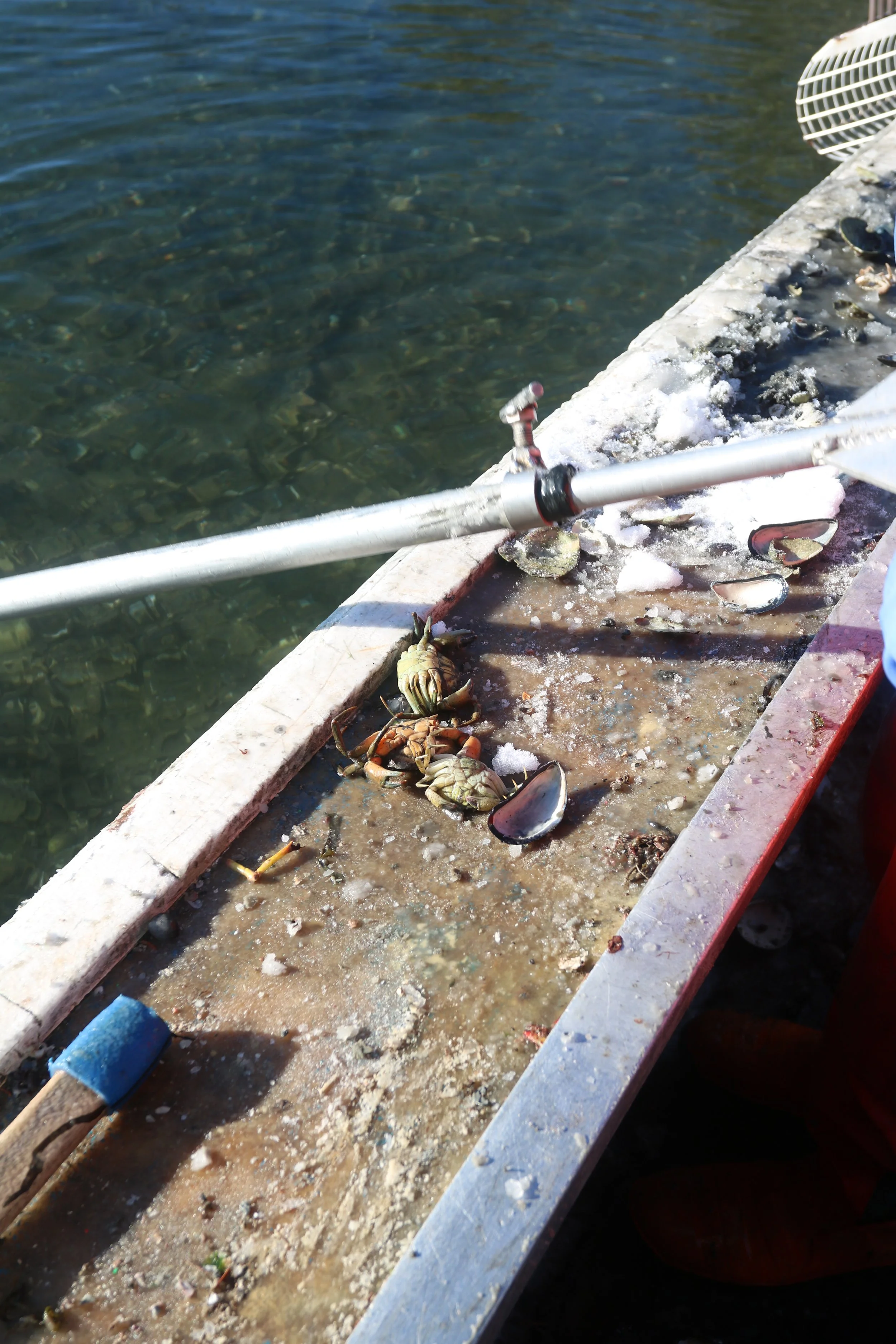
Instead of answering directly, he plucked an empty soft shell clam from the basket. He described how the layers of shells represent ecological cycles, how the diversity of species undulates and how the patterns of fisheries should echo these undulations, instead of attempting to harvest and sell the same type and quantity of product season after season. Most people won’t notice these cycles. Harvesters do, of course. They have to. “Gulls eat the quahogs too,” he said, pointing out vast piles of white shells along the banks.
Later, back on land, when I asked him more about this cycle, he said: “I was showing you die- off, that’s the generations. Other clammers could tell you more. But if people understood die-off and cycles, more of this would be a lot easier going.” In this, I hear an intuitive form of knowledge coming through. A quiet knowledge that is absorbed through daily practice and multiple generations, but that gains solidity and volume when other types of knowledge grind up against it – or question its veracity.
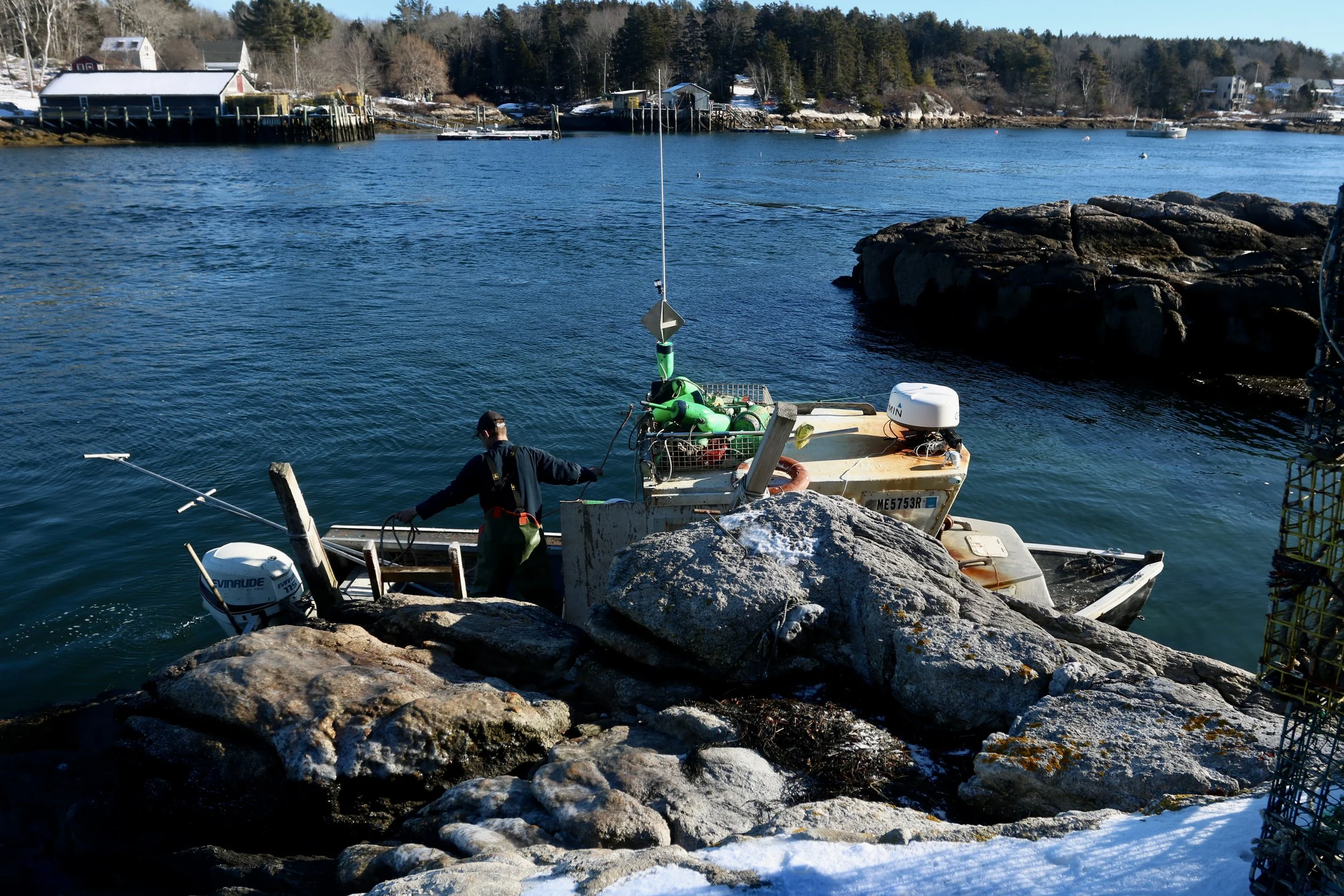
ON OUR WAY back into the boatyard, we stopped at Malaga Island. His mother’s side is from Malaga, and there’s a bit of property there, grandfathered in. We tied up, climbed an icy ladder, and traipsed about through turkey tracks for a bit. He pointed out coils of rope poking up out of the frozen and snow. “I’ve picked up twenty-five boatloads of trash, four old traps,” he said. “It’s stuff like that that gives fishermen a bad name.” One fisherman does something misguided and then people arrive with their own ideas and judge all fishermen by the mess of one. We talked about how fishermen get laden with and then have to carry negative stigma, a stigma that makes everything that much harder – from working with regulators, to getting bank loans, to having friendly neighbors, to making a livelihood off the water they grew up on. It’s tough to point a finger at where such stigma comes from, and so it's tough to fix it. This sort of murkiness, for better and for worse, is the real meat of what forms cultures and the gaps between them.
Adam Kernan-Schloss, one of my advisers here, and I talk quite a bit about culture on the peninsula. We’re both newcomers, who share, I think, a fundamental curiosity about why people do what they do and think what they think – ourselves included. Lately, we’ve been wondering about the threads of culture that shape our own lives and fundamental belief patterns. It’s really tricky, we’re finding, to see one’s own cultural marrow. It’s much easier to look at somebody else, to assume things. I try to remember, when I have the wherewithal, that assumptions of any one “proper” type of or normality are, at best, misguided, and at worst, harmful.
But a strange coastline like Phippsburg’s is a great place to consider the infinite scope of cultures. We’re a pretty small place – and yet in these sixteen miles we pack all sorts of education, backgrounds and ideas of what makes for a good life.
Dan’s education is as wide and diverse as Phippsburg’s shore. “He’s the hardest working on the water,” his uncle Terry told me, “it doesn’t matter what fishery he gets into.” A wide education and the ability to pivot based on ecological and economic patterns makes for a more sustainable harvest.
AS A YOUNGER person, I wasn’t a naturally talented student. That is, I was a subpar test taker, couldn’t remember and regurgitate dates or names, and my concentration in lectures was generally lacking. I did alright because it didn’t seem like there was another option. In retrospect, I see how the narrow funnel of the school system felt unnatural to me and how, in that system of consistent comparison, my confidence took a beating. I developed a lasting sense that I wasn’t very smart. Of course, this seems a little silly now. But if, day in and day out, a child is getting measured by one very specific set of standards, and if that child is told that that set of standards will be how their life is measured, of course a faulty set of assumptions might arise.
Working in Alaskan fisheries was my introduction to a new way of learning – and a new way of thinking. Suddenly, I was absorbing the patterns of global systems by associating concepts to the physical realities of the water. My education took on a constellatory, interconnected nature. I left behind, as best I could, the notion that learning should be linear. Out on the northern waters, the ways in which the billowing margins of global trade have shaped not only history but the selective nature of its recording, became clear. It was like opening a door and finding a whole new way of seeing the world. Writing was also a perfect way to explore how thoughts are associated – and a good method to begin studying the make-up and impact of culture, how difficult it is to pull the sticky threads apart that make the weave of cultural norms. In commercial fishing, one often has the sense that there will always be another thing to learn, another way to operate. I think that’s why, in part, people love it so much. You can never really master it. In writing and research, I found a parallel sense: There is always a deeper, more complex and thus empathetic way understand this world, its systems and its people.
Here’s the brief academic tangent I warned you about. Lately, I keep thinking about a paper that I read over the summer, “From Sacrifice to Slaughter” (Reed, 2017). Reed discusses the changing relationship between humans and the food we eat. She describes how meat, being less easily acquired and consumed, was once more sacred than it is today. In earlier history, humans lived among the animals they consumed and therefore were more intimately engaged with the cycles of the animal’s life, death and the processes necessary for its consumption. Now, however, as small butchers and local fishers are blown out by mega-slaughterhouses and big trawlers that produce anonymous, cheaper foods, the relationship to not only that food but the people who harvest it changes. With distance comes obscurity, stigma and cultural gaps.
Here in Phippsburg, if you aren’t a fisherman or woman – that is, if you aren’t harvesting food for our coastal population – you likely know someone who is. In my view, if you have enough solid, nutritious food to eat and your community is strong and healthy, life can be good. I’ve been thinking about this paper, “From Sacrifice to Slaughter,” because it seems that here in Phippsburg, we are experiencing a sudden, inverse trend. More consumers are now moving from cities, where evidence of food production is sometimes hard to find, toward the very locus of the harvest. The paper doesn’t address this demographic shift. It does, however, talk about how culture is tied to and emerges from food systems and our relationships to them, and how with separation of producer from consumer, there is also a separation of culture. Today, on this slim peninsula, separated cultures are meeting and re-understanding what cohabitation means. Newcomers like me are interacting more regularly with natives like Dan, his uncle Terry, and my new friend Robin Wallace. It’s no secret that it’s a materially and existentially uncomfortable moment. And yet look at this place! Look at the abundant diversity in our waters and land!
After chatting with Dan about “traditional” education – that is, an education that follows the fairly narrow norms and regulations of governing bodies, versus an education based on personal observation, generational knowledge and creative problem solving – I’m thinking a lot about the perfect strangeness of the times we live in and the necessity of collaboration between various sets of knowledge-holders.
Some of the best collaborations and conversations I’ve seen lately are between groups like Manomet and the Phippsburg Shellfish Commission. Manomet is a research organization which employs a lot of people with advanced academic degrees. The Phippsburg Shellfish Commission is a collective of local commercial shellfish harvesters, mostly clammers. The diversity of “traditional education” is wider here, ranging from those who never finished high school to those with advanced degrees – the important knowledge for this group is instead based in the harvest. When groups like Manomet and the Shellfish commission work together, their knowledge more than doubles. Their educational sets complement each other, fill in each other’s gaps, ask new questions and find new answers. It’s exciting to witness. These groups respect each other. They understand not only their own holes in knowledge but how each can help fill in what’s missing. Out of that mutual respect comes easy collaboration, new ideas and long-term relationships with people, water and the systems that impact both.
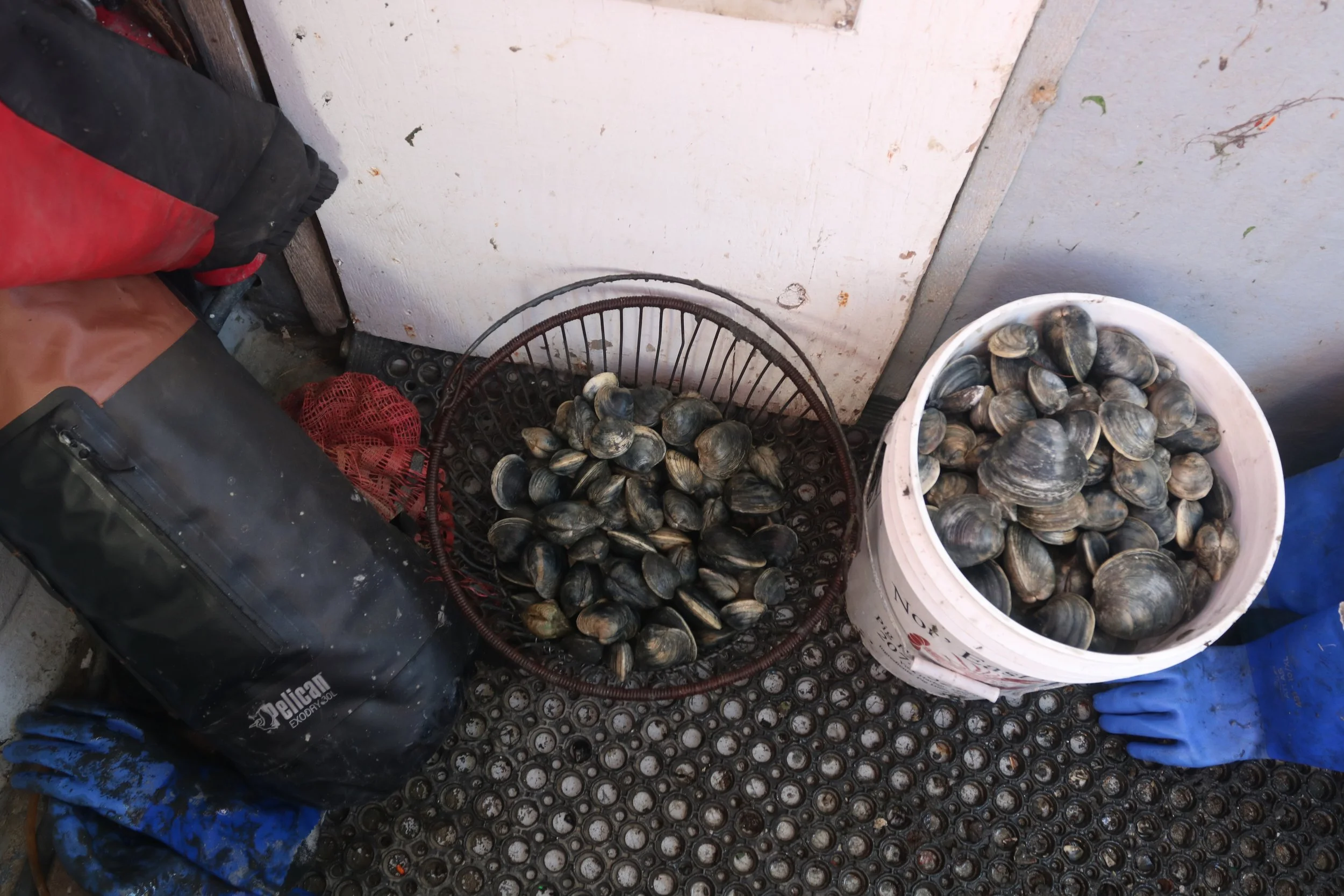
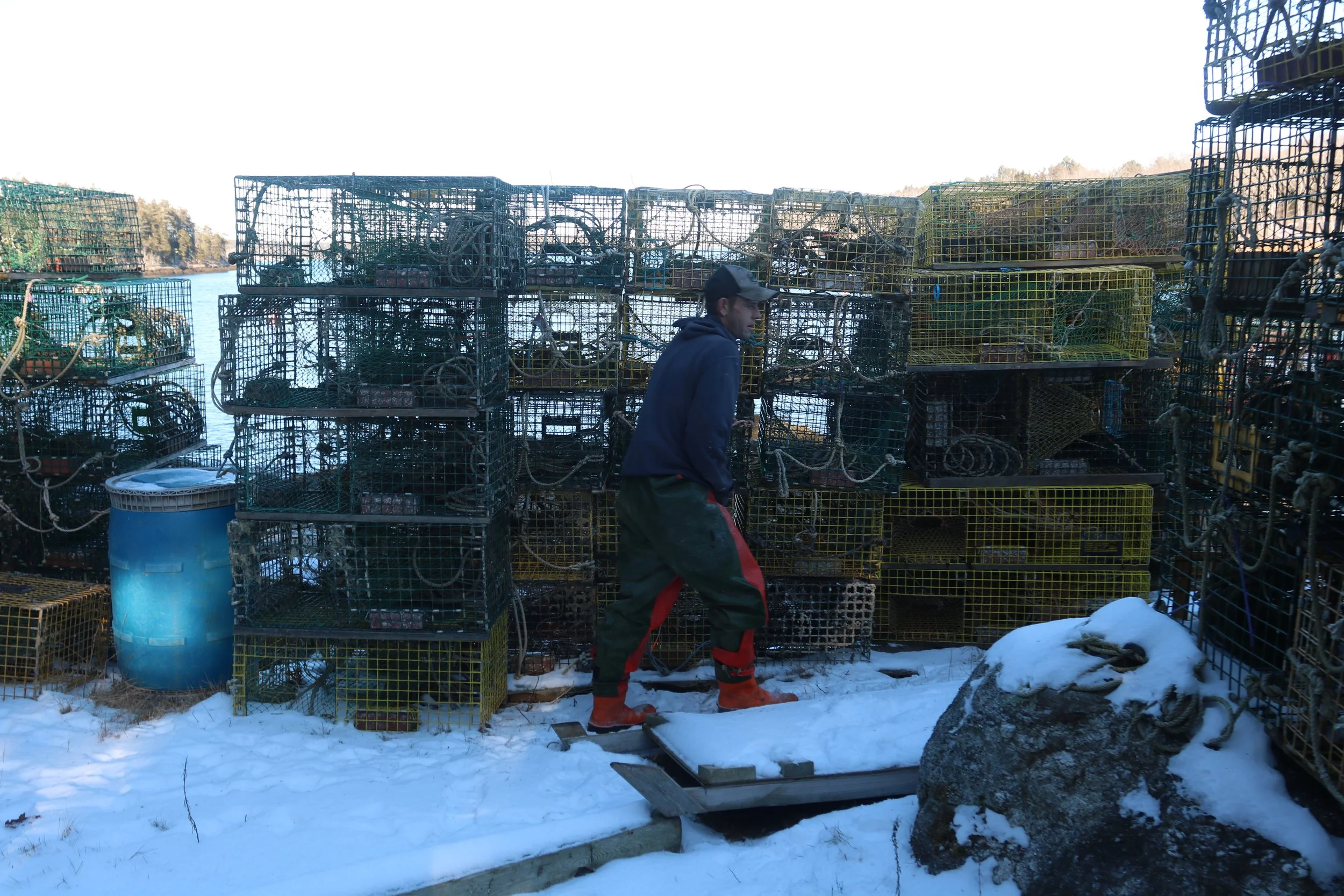
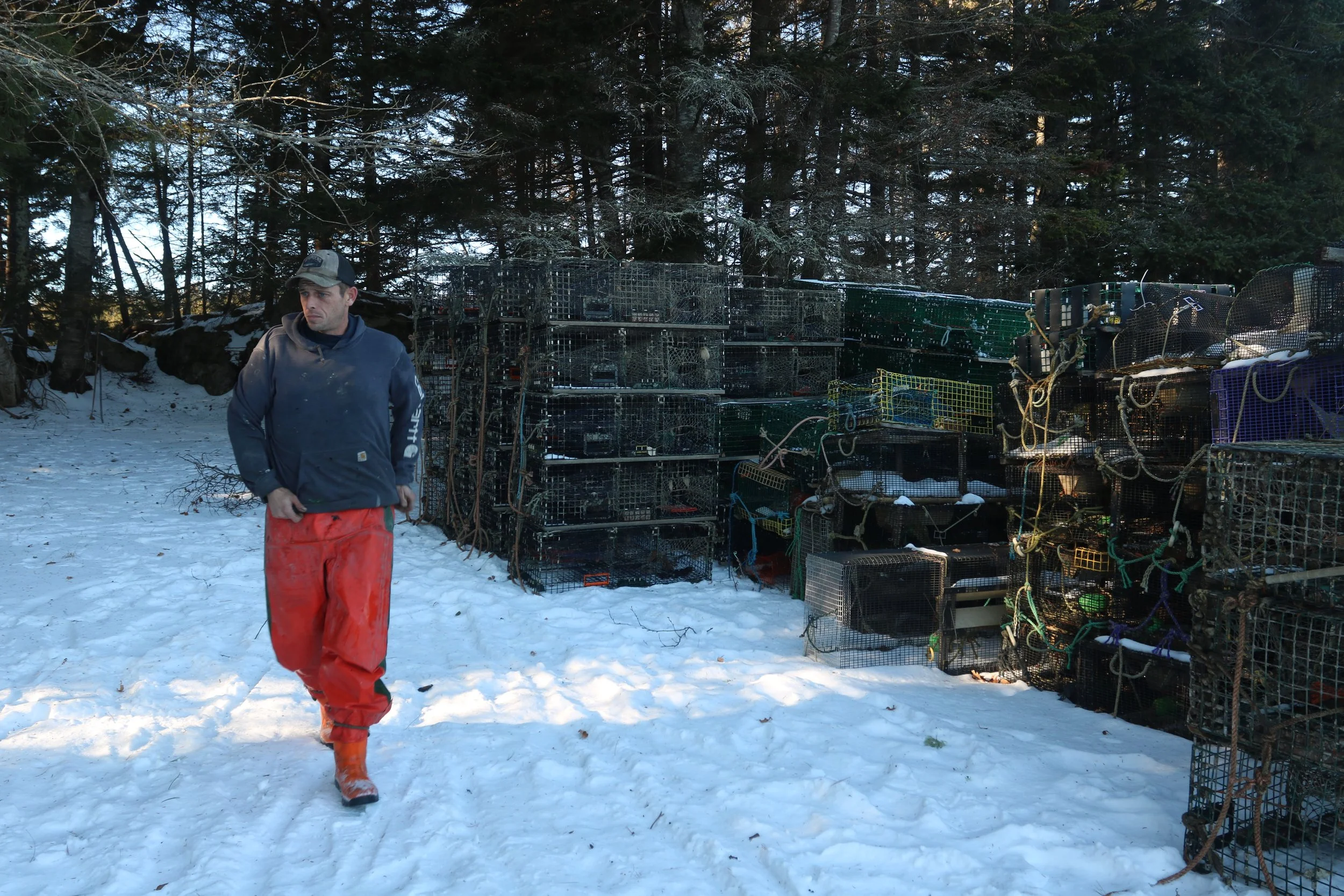
DAN FISHES FOR and harvests a bit of everything. Lobster, soft shell clams, quahogs, kelp – to name just a few. When I first connected with him, and mentioned how diverse I understood his harvestry focus to be, he laughed and described himself as a guy with a “fishing addiction.” But the more I think about it, the more I feel that what he describes as a “fishing addiction” more simply reflects a variety of enmeshed things: not only a wild work ethic and a love of water, but also a much more traditional – and sustainable – mode of harvesting.
My research often looks at the historical moment when global trade enters an ecosystem. Whenever a good becomes a commodity (whether it’s codfish or corn) there is a loss of harvest diversity. To bet on big industry, the monetary output of that industry needs to maintain stable growth, regardless of the natural ecological fluctuations. Specialization rules. The system we live and eat in now is a result of global commodification. One can always buy salmon and bananas! It feels quite natural – because it’s all that we know! But in the whole scheme of our species’ existence, food was so much more diverse than it is today.
When I worked on Alaskan vessels, for example, I’d often use the galley kitchen and cook up the bycatch – all the “odd” fish that there was no market for or that were simply too cost-prohibitive for a vessel like that to process and store. Sometimes, down in a vessel’s factory gut, someone would pass me an urchin. With the tip of a Vicky, we’d scoop out and eat the orange roe. On one vessel, the engineers made their own cod liver oil. I’d take a healthy shot of it with my coffee.
During my very last contract, when slow fishing meant our trips at sea stretched from the anticipated two weeks to four or five, and our fresh food ran out, I’d sometimes spend the twelve-hour offloads between these trips out in the Aleutian hills, foraging for berries, spruce tips, beach greens. Paradoxically, though these massive bottom trawlers are part of a horrifically unsustainable mode of fishing, in which tens of thousands of tons of bycatch can be wasted in a day, I sometimes experienced an incredibly diverse, fresh diet – one that fit the marine ecosystem I was living in.
I see in Dan’s widespread foci adaptability and sustainable diversification. Dan doesn’t seem to target any one specific species and therefore doesn’t rely on any one species. This means that ecological and economic fluctuations might not impact him in the same way that they’d impact a single-species fisherman. But it takes, of course, not only a diverse harvest, but a diverse palette to match, to return to a more sustainable foodwebs. This is a sixteen-mile peninsula with a diverse abundance of coastline. Just as there is no one type of habitat here, there is no one way of being. Scientists and harvesters, writers and fishermen, older advisers and younger Fellows – all trying to navigate a complicated world.
Food binds communities, eases conversation, provides a central focus to so many traditions. It’s Winter suddenly – a time for warm feasts. With too much distance – cultural or geographic – between ourselves and the ecosystems that food comes from, it’s possible to take for granted that it will arrive, unblemished and unchanging on our grocery store shelves. Why is it then, that our traditions still center us around food? Is it because, though life tries to distract us with a host of other shiny consumables, we still, at base, consider food sacred? Maybe so, even just on some subconscious level.
Phippsburg is turning out to be a good place to think about food, its sacredness and each of our positions in the food webs we live in. After that chilly morning on the water with Dan, I’m thinking more than usual about the abundance of our marine systems – and the shifting diversity of our peninsula. I’m wondering what I have yet to learn.
Sources.
Reed, Annette Y. “Annette Y. Reed, ‘From Sacrifice to the Slaughterhouse: Ancient and Modern Perspectives on Meat, Ritual, and Civilization,’ Method & Theory in the Study of Religion 26:2 (May 2014): 111-158,” n.d.